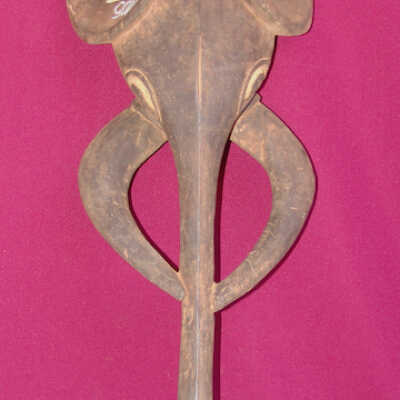
Mask
Typical horizontal elephant mask with large oval ears, long trunk, tusks that curve out, around and back to touch the trunk. Carved out eyes and teeth. Surface shows chisel marks. Forehead deliberately scarred. Painted overall with black pigment, left light around features.
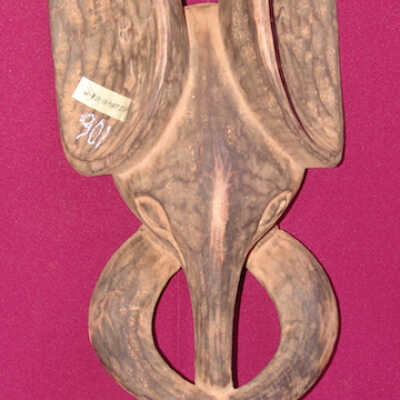
Mask
Typical horizontal elephant mask with large oval ears, trunk that curves up, tusks that curve out, around and back to touch each other on top of the trunk. Carved out eyes and teeth. Surface shows chisel marks. Ears have carved diamond shaped holes
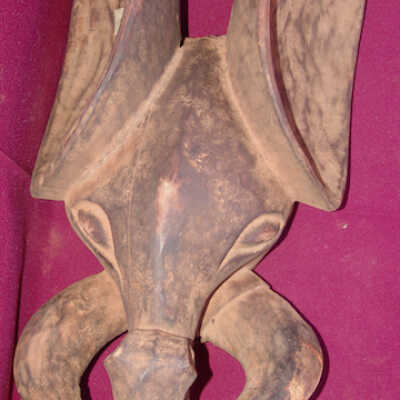
Mask
Horizontal elephant mask with large oval ears, trunk that curves up around and folded back, tusks that curve out, around and back to touch the top of the trunk. Carved out eyes and teeth. Surface shows chisel marks.
Mask
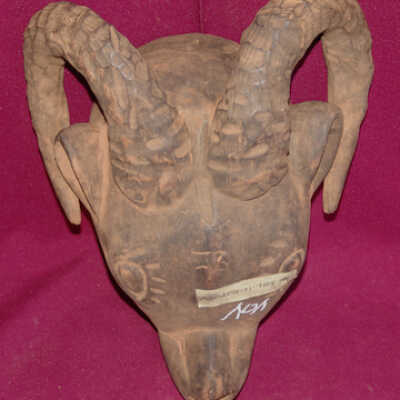
Zoomorphic horizontal mask in the form of a ram's head. Curved horns that turn around the ears, highly carved on their surface. Mark on forehead. Open mouth showing upper teeth.
Mask
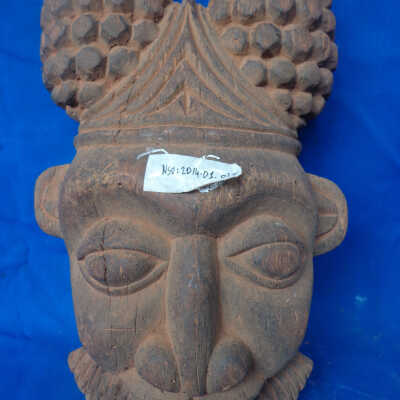
Mask in the form of a man's head wearing a traditional title-holder's cap
Mask
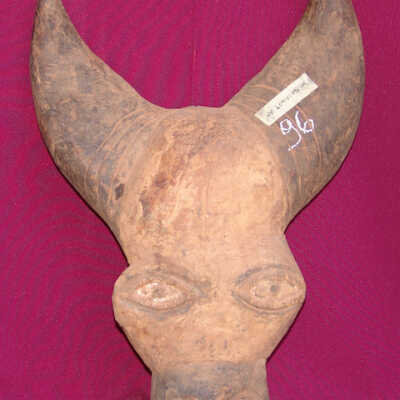
Horizontal zoomorphic mask representing an ox. Flat, horizontal large horns and snout are painted black. Large nostrils and eyes carved on top of the mask.
Mask
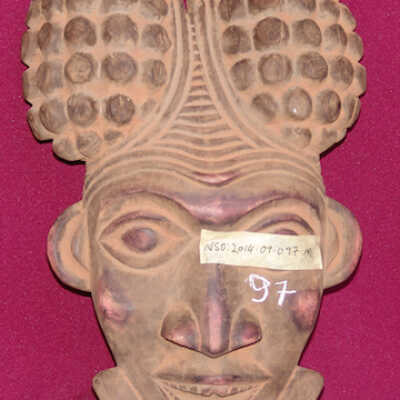
Horizontal anthropomorphic mask representing a Shey (title holder) wearing a traditional divided cap, with open smiling mouth showing its teeth. Face has been painted with red pigment.
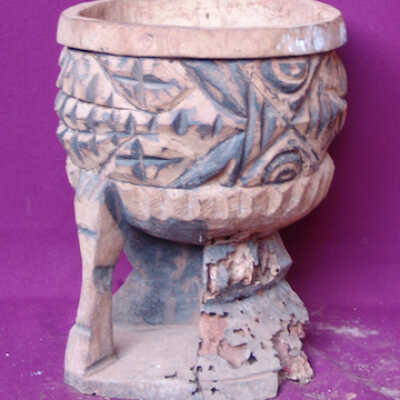
Mortar
Cylindrical mortar bowl decorated with crocodile carved and painted black encircling its sides. Pedestal with an animal foot/leg shaped handle and solid semi-circular base set on a solid circle.
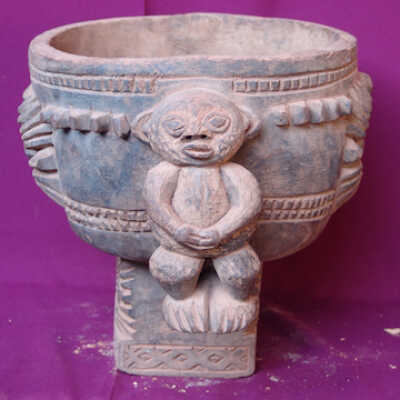
Mortar
Highly decorated mortar. Bowl is carved with figures of two spiders, handles comprised of two small children, and geometric/rectangular shapes around the edges. One child has a closed mouth, hands folded together. The other child has an open mouth, hands apart one above the other, with an X on its belly. Stands on a base with four spiders holding the bowl, and standing on a rectangular open pedestal carved with diamond shaped decorations
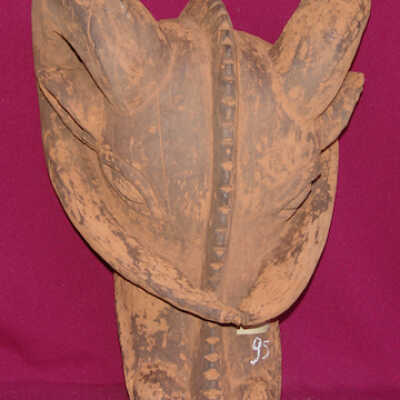
Ox mask
Horizontal zoomorphic mask, with long curved horns that meet on top of the snout, a crocodile tail like carving from tip of nose across the snout and forehead, and large teeth in an open mouth.
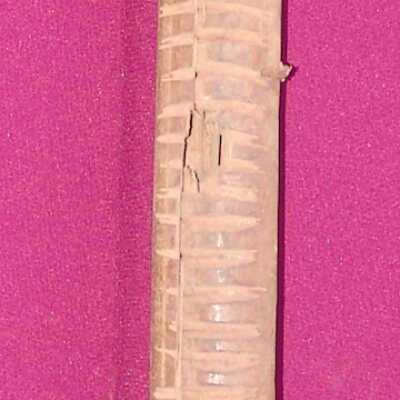
Percussion instrument
Long open tube carved with vertical slit about 1 m wide down its length, and horizontally carved gouges about 1 cm apart for creating the percussive effect. A stick is scraped against the ridges in rhythmic patterns.
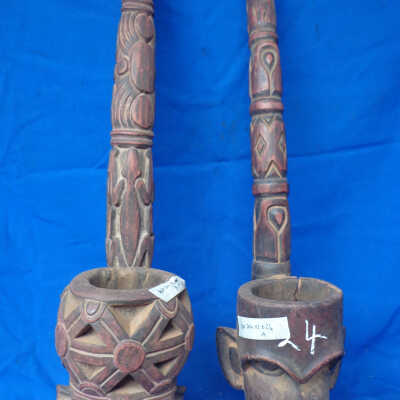
Pipe
"A" has a bowl in the form of an ordinary man's head. The stem is ornately carved with double gongs all around it separated by rings and areas of geometric shapes. "B" has a bowl in the form of a title-holder's head with full cheeks wearing a cap decorated with star-like forms. The stem is carved with lizards and spiders separated by rings.
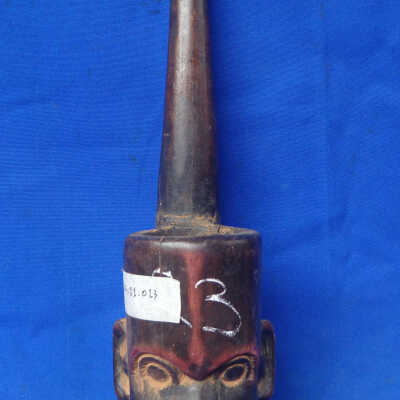
Pipe
Long stemmed pipe with a bowl in the form of an elderly man's head
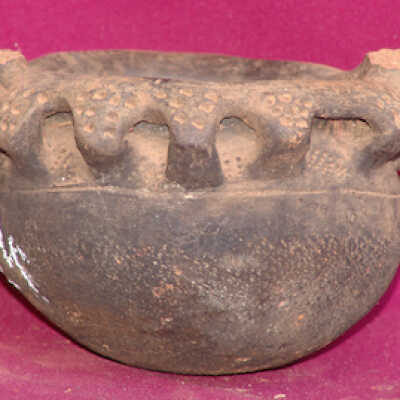
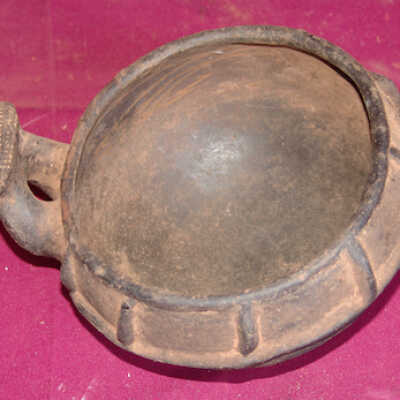
Pot
Round bowl with decorated edge, a handle on one side and knob/protrusion opposite.
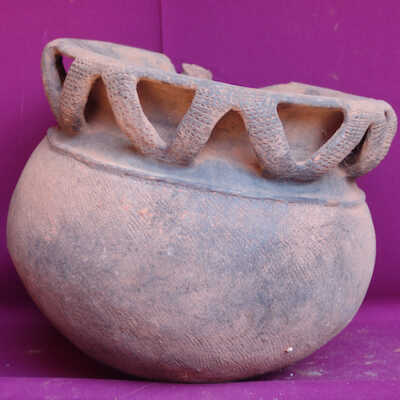
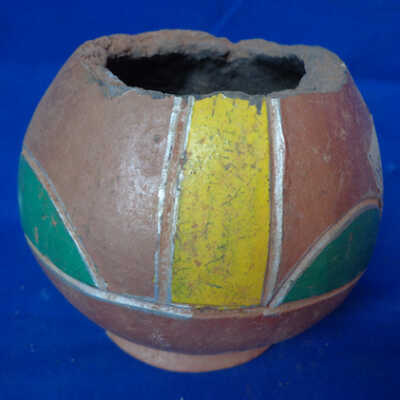
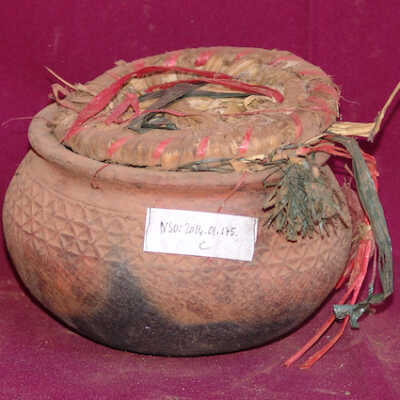
Pot with cover
A round, round bottomed clay pot with smooth curved rim, outside textured with textile pressed into wet clay and linked triangle patterns in a band towards the top. Bottom shows signs of having been set onto a fire.\nRound raffia cover, with some strands dyed pink and green, mostly natural tan color.\nContains seeds and organic matter\n
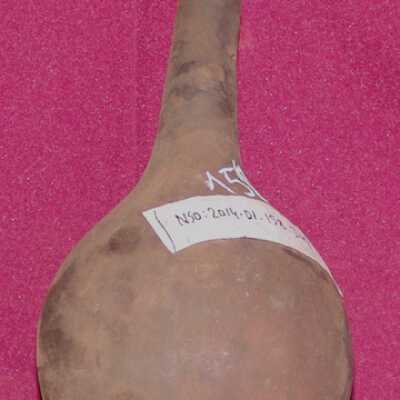
Rattle
Round bellied dry calabash with a long stem with a hole at the end, filled with dried seeds that rattle when shaken.
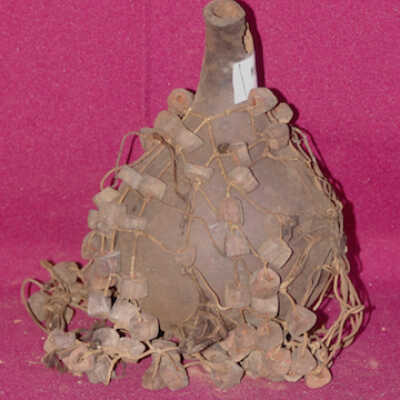
Rattle
Round-bellied dry calabash covered with a loose woven mesh threaded with seed beads that rattle against the body of the calabash when shaken.
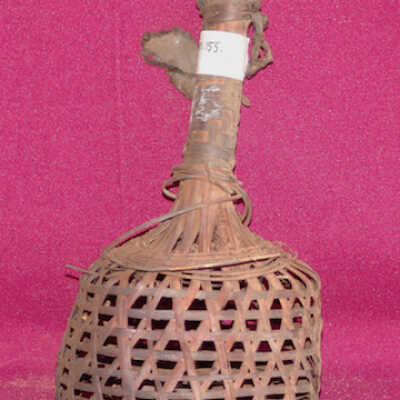
Rattle
Basket-woven rattle containing seeds, with solid, wrapped handle.
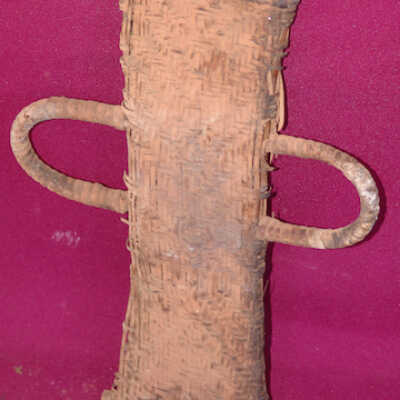
Scabbard
Flat scabbard woven of raffia fiber with handles on either side.
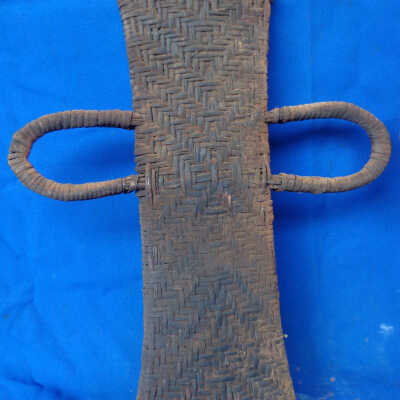
Scabbard and cutlass
Two woven bamboo scabbards with pairs of round handles on the sides. One contains an iron cutlass
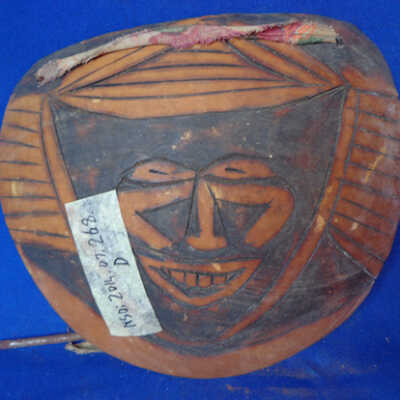
Scoop
Scoop made of calabash, back is carved and burned with an image of a smiling face. It has holes carved for inserting a piece of cloth by which to hang it for storage.
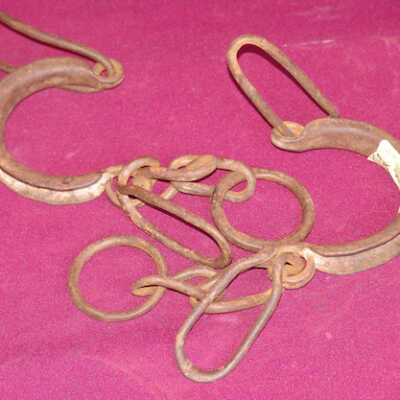
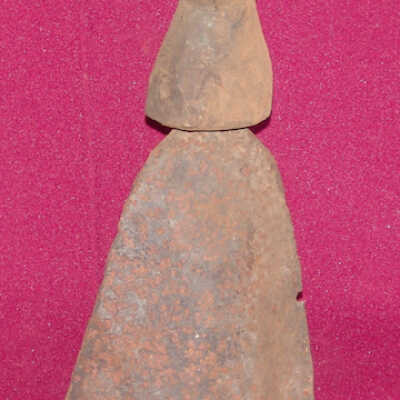
Single gong
Iron smelted bell with wooden handle carved with horizontal bands
Slit drum
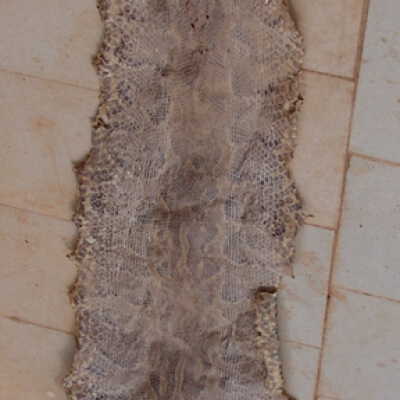
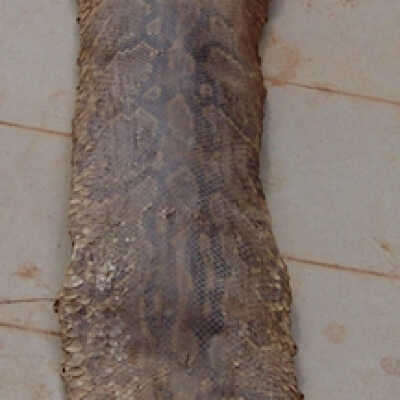
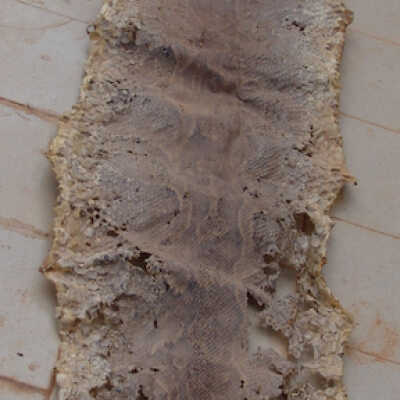
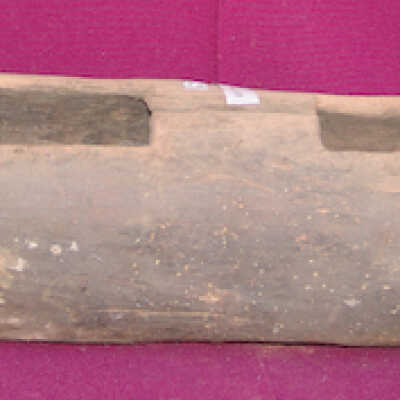
Round, hollow slit drum with plain handles, no decoration. Opening a narrow slit on top opening up to rectangular holes at either end.
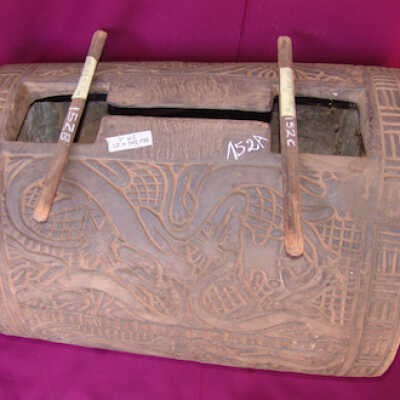
Slit drum and beaters
Elaborately carved, horizonal cylindrical drum. Handles are two smiling human faces. Surface carved with 12 lizards facing in alternate directions. Also two spider shapes and a plant form. In between the lizards are carved variously sized rectangular shapes, and around the edges a border of alternating vertical and horizontal lines. Ends and bottom of drum are plain. Opening is a vertical slit with larger rectangular openings at each end. Beaters are smooth rods made of bamboo.
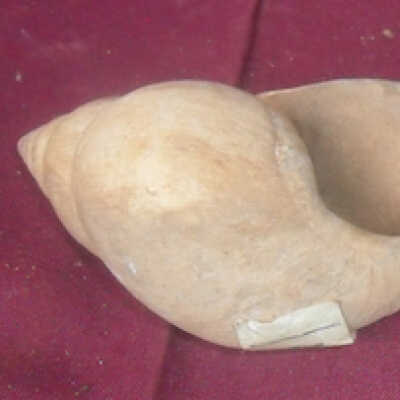
Snail shells
Natural land snail shells
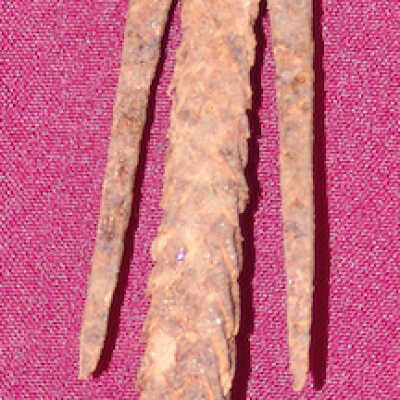
Spear
Long wooden shaft with iron tip, attachment point has been decorated with texture on the surface
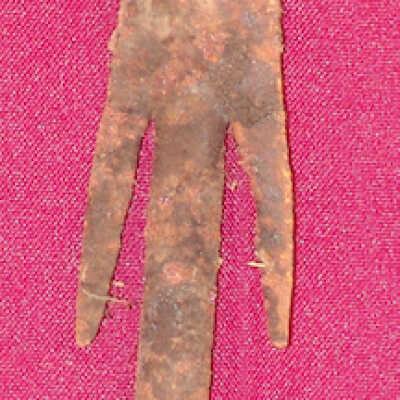
Spear
Long shaft with iron spear head. Fiber cord attached to the head.
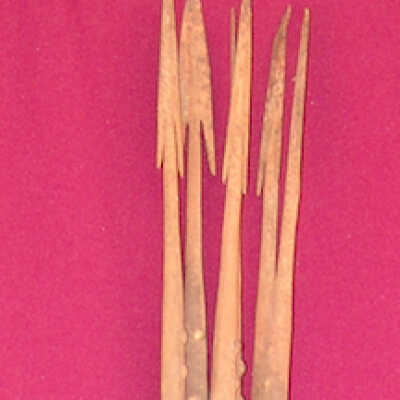
Spear
Six spears with long wooden shafts and iron tips attached to the shaft with brass tacks and copper wire wound around the base. Also wound with a piece of animal pelt.
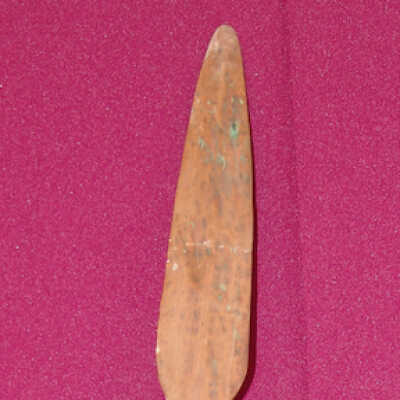
Spear
Long wooden spear with a sharp, forged iron tip.
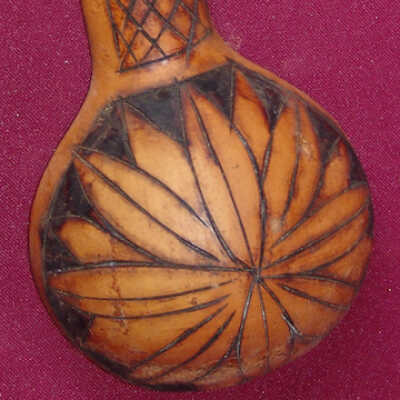
Spoon
Spoon made from a halved long-necked calabash. Back decorated with geometric and plant forms by carving and burning.
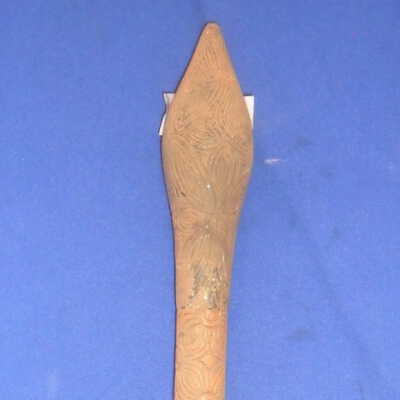
Staff
Staff with diamond shaped handle. Elaborately carved overall with spider patterns
Staff
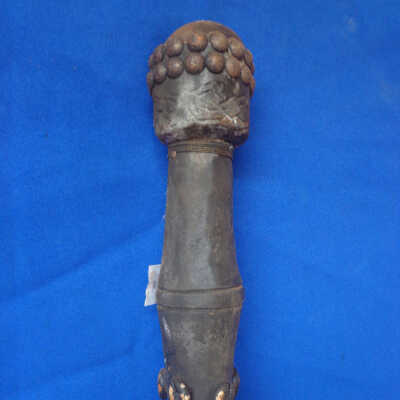
Long staff with knob handle. Decorated with cowrie shells, brass tacks, wire, and pigment
Staff
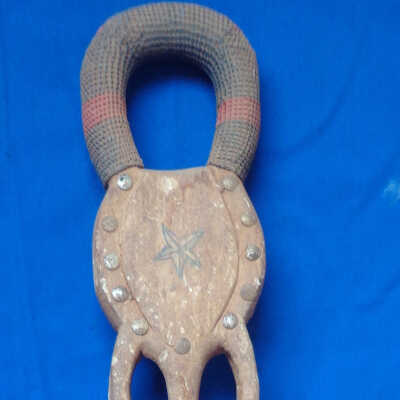
Staff with ovoid open carved handle wrapped in woven copper wire. Below the handle two elephant heads decorated with brass tacks, carving and a painted star. Below the elephant heads shaft is wrapped in wire and carved with schematic spder and spiral shapes.
Staff
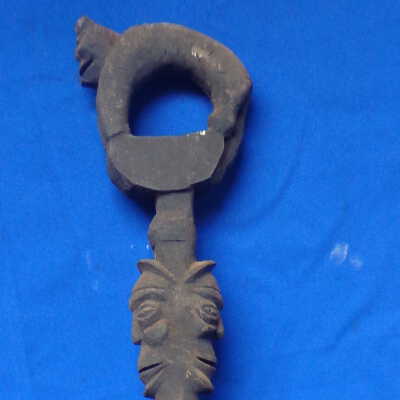
Handle ovoid open in the form of a leopard. Below the handle Janus head--opposing faces, full figure below carrying a double gong, wearing a loin cloth
Staff
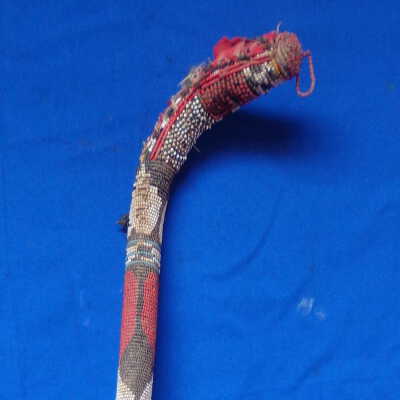
Curved cane like staff covered in red, white, yellow, black and blue glass beads on fabric covering the wood base. Metal tip
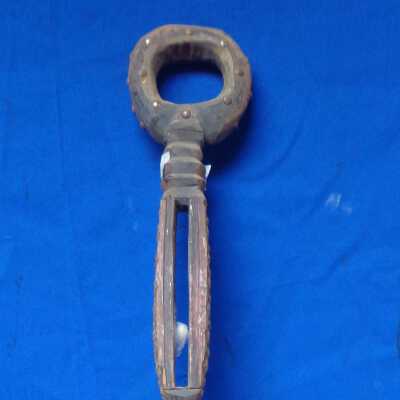
Staff
Staff with a round, open handle studded with brass tacks. Below the handle carved rings above a long open oval shape. Below the long oval, deeply carved diamond patterns along the length. Tipped with iron.
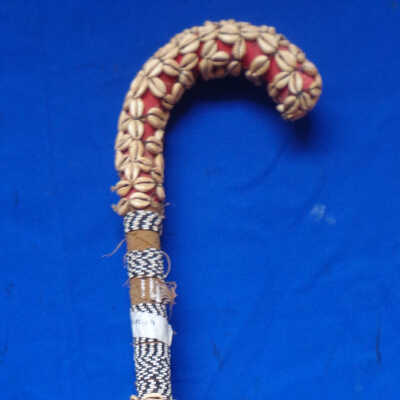
Staff
Cane-shaped staff of wood covered with red cloth and decorated with cowrie shells on the handle and in two bands around the shaft and near the tip, with small black and white beads filling in the gaps. metal tip.
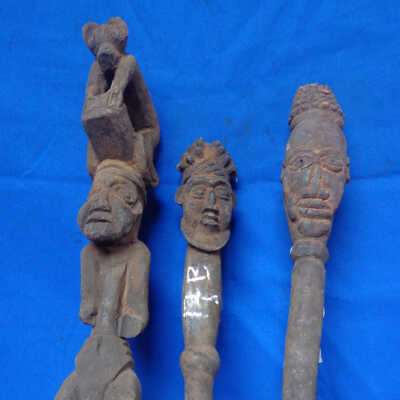
Staff
Three staffs with handles in the form of a man's head. All are wearing traditional caps. One is the full figure and has a dog like animal riding on his head.
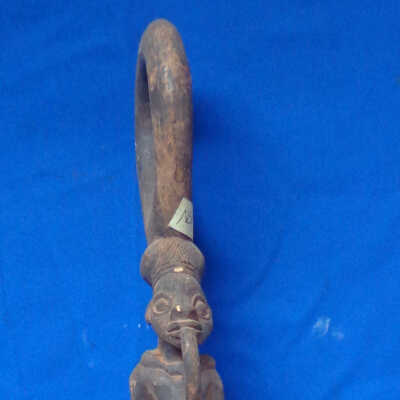
Staff
Staff with an open round handle sitting on the head of a full figure of a man wearing a traditional cap, loin cloth, smoking a pipe.
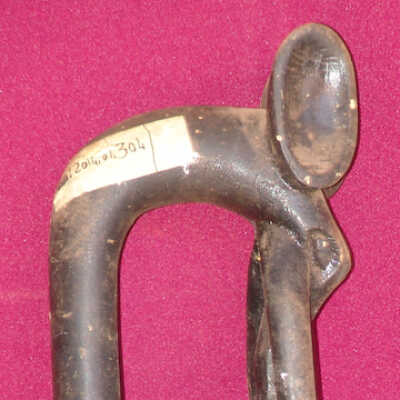
Staff
Staff with a handle in the form of an elephant that is standing on the head of a male figure wearing a traditional cap and small loin cloth. He is holding the horns of an antelope head whose nose rests on his feet. He is standing on three crocodiles noses, their bodies extend down the stick. Last section is uncarved.
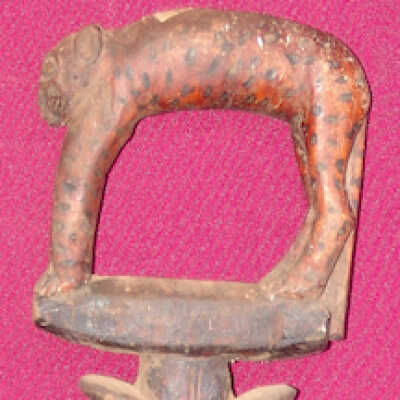
Staff
Staff with a handle in the form of a crouching spotted leopard standing on a plain foot rest under which are two men's heads wearing traditional caps and large beaded necklaces. They are connected at the base of their necks. Under them is a full figure of a man sitting on a stool carved with cowrie shapes around its edges and standing on four legs. He is holding a palm cup in his right hand and a small calabash in his left. He also wears a cap, beads and loin cloth. The stick extends to four horizontally carved shapes and ends in a metal spike with a sharply pointed end.
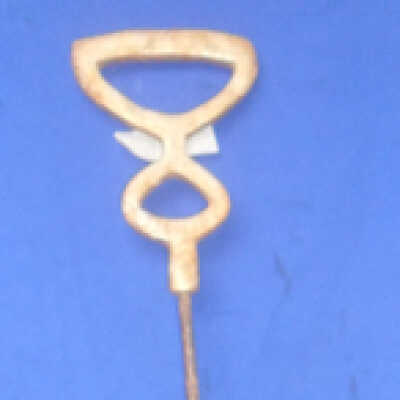
Staff
Open work metal handle on a wooden shaft with a metal tip at the bottom
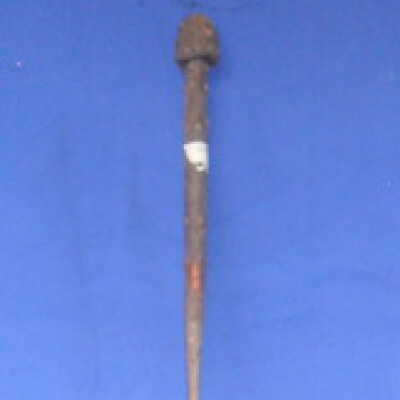
Staff
Black staff with knobbed handle decorated with carving and lozenge shaped buttons. Handle connected to shaft with copper wire. Shaft formed with two open worked areas ending in a blade shaped point.
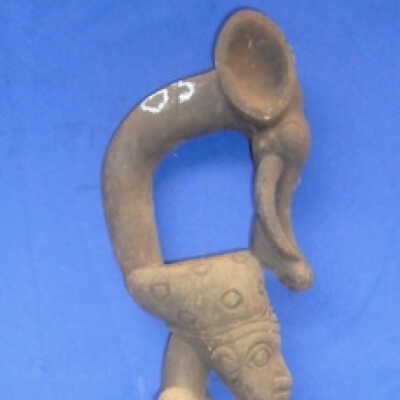
Staff
Anthropo-zoomorphic staff. Elaborately carved with three lizards, the head of an elephant, a buffalo,and three human heads. Full figure of a man holding the head of an elephant
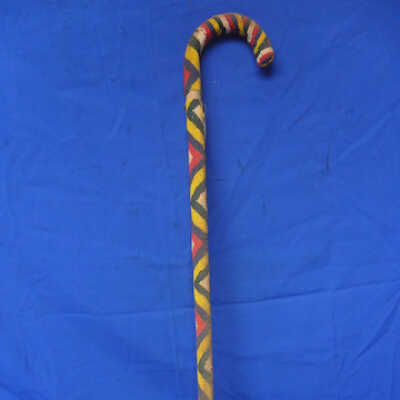
Staff
Cane-like staff of wood covered in geometric patterned black, white, blue, yellow and red bead work with a metal tip
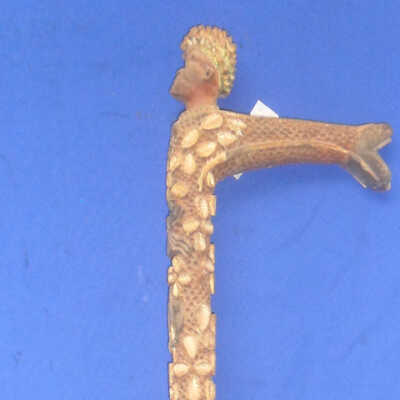
Staff
Elaborately carved wooden staff in the form of a snake with a human head on the handle. Also carved and painted with images of cowries, spiders, double gongs and plant forms. Tipped with iron point
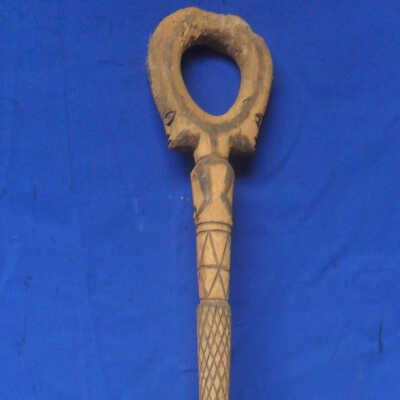
Staff
Staff with oval open worked handle formed by two carved and painted human heads. Shaft partly decorated with figures' arms and upper bodies, and triangle/diamond shaped patterns
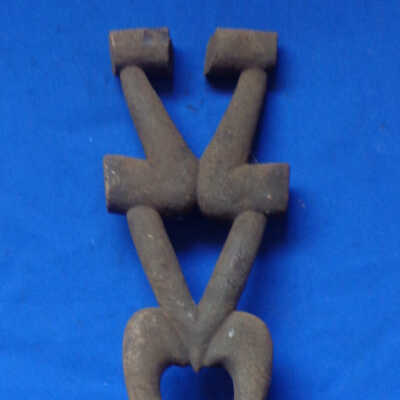
Staff
Shaft splits in two part way up and forms open oval, heart, triangle and "Z" shapes that form the handle. The initial split starts to form what appears to be two facing birds whose heads meet at the top of the heart shape. Tip is covered with aluminum.
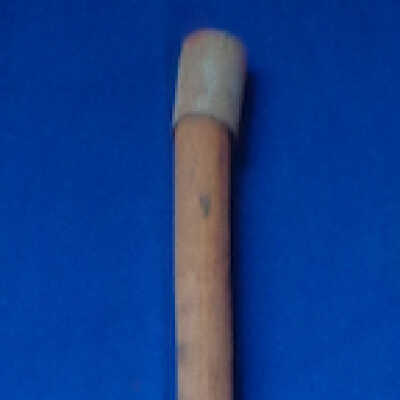
Staff
Long staff, decorated with black stripes and topped with plastic.
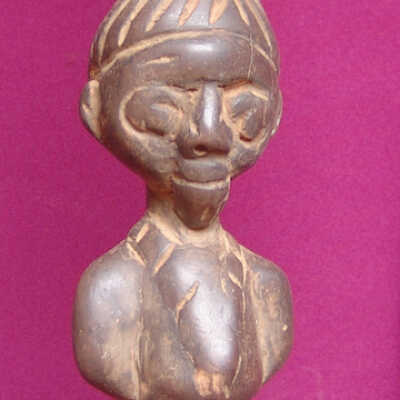
Staff
Anthropomorphic sculpture of busts of three men one on top of the other in order of their social position in the hierarchy/age, the one on top is wearing notable's cap. All are wearing beaded necklaces. Painted black.
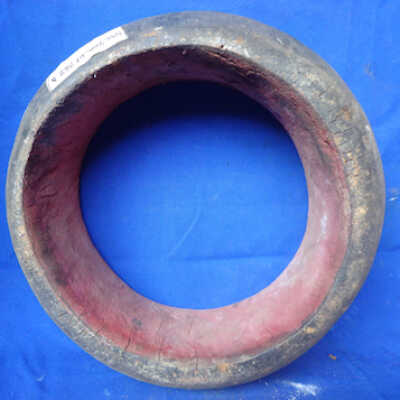
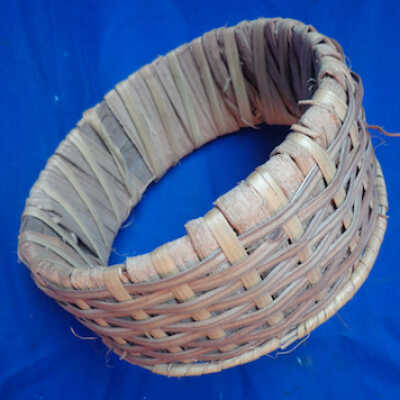
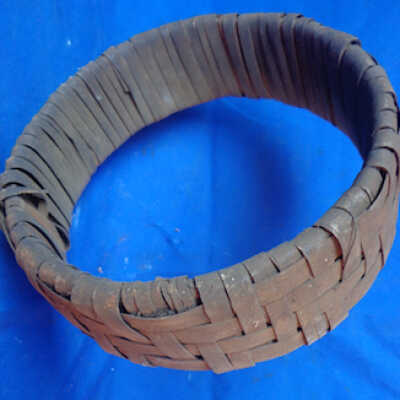
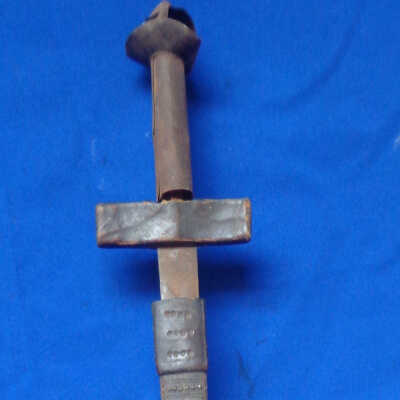
Sword and Sheath
Long sword with a leather covered cross shaped handle. Sheath of leather embossed with circle and heart shapes, and snake-like lines down its length
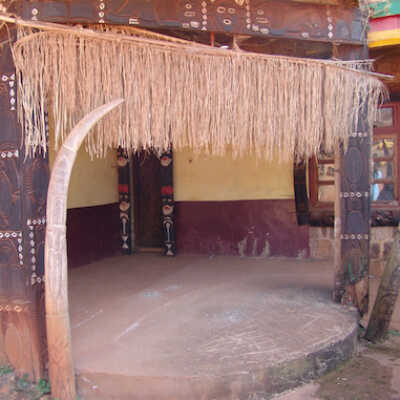
Throne room
Posts are carved on all four sides with double gongs, combined reptile/spider forms, cowrie shell shapes painted white, and men's faces. Lintel carved with a man's face crowned with cowrie shapes framed by lions in profile on either side, double gongs at the far corners. In front of the posts are large, ornately carved forms of elephant tusks. A branch of raffia palm is placed in front of the lintel to restrict access.
Traditional bag
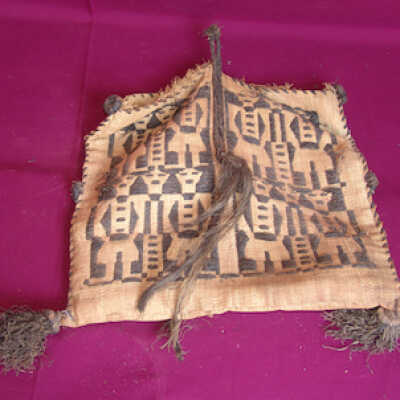
Flat bag woven with light and dark fiber to form a pattern of twelve male figures on the front side of the bag. Corners are fringed with darker colored fiber, as is the braided, looped handle.
Traditional bag
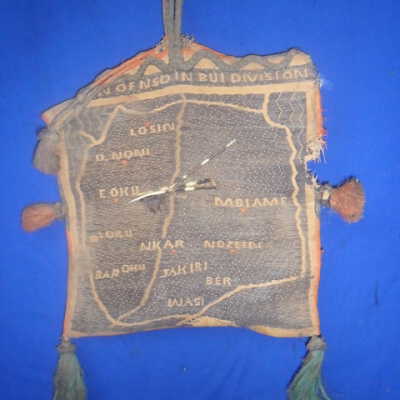
Traditional raffia bag with woven design of the map of Bui Division, naming the primary sub-kingdoms: Losin, Noni, Oku, Mbiame, Nkar, Ndzeem, Bar, Jakiri, Ber, Wasi. At the center is Kumbo, which is covered by 3 porcupine quills. Woven black raffia handle that curves along the top edge of the back. Decorated with long black and green tassels on the bottom corners, shorter ones on the upper corners, and short red ones along the side
Traditional bag
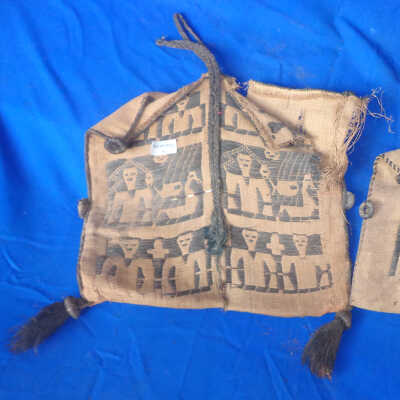
Flat raffia bags with black figures and designs woven into them. Handles of black raffia braided and stitched part way down the center of the bag. Lower corners have black tassels. Edges decorated with black circular woven appendages. "A" has two figures on the front, "B" has twelve human figures, two animals that may be horses, and two fish like figures.
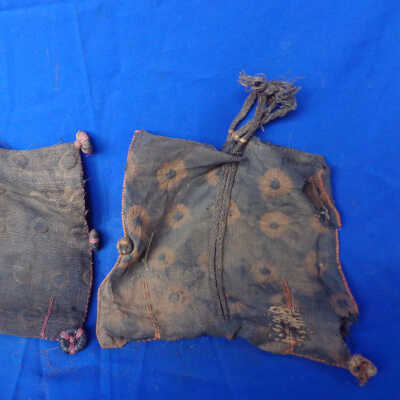
Traditional bag
Tightly woven flat bags with braided raffia handles and edges. Embellished with circular woven appendages at the corners and along the sides. "A" is black with red tie-died circles and red trim. "B" is purple with some red along the edges and in the appendages.
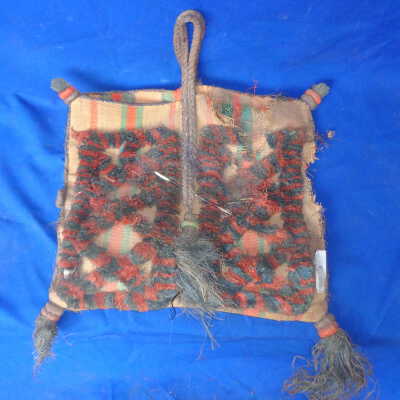
Traditional bag
Flat woven raffia bag with red, green and tan vertical stripes woven in. Front is decorated with tufted red, blue, and black diamond shapes set into two rectangles. Handle is black braided raffia. Corners were decorated with black fringe set into circular woven appendages. A porcupine quill is stuck into the braid on the front of the bag.
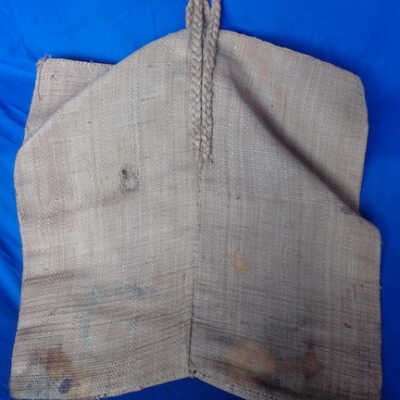
Traditional bag
Plain flat bag with braided handles
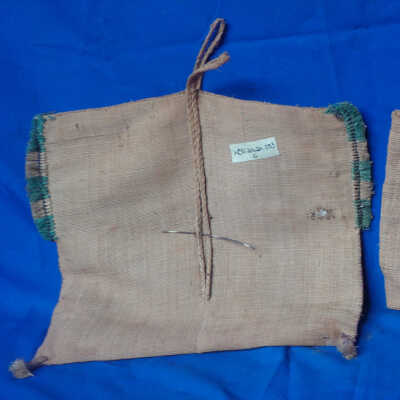
Traditional bags
Plain woven raffia bags with braided handles. "C" is decorated with a green striped fringe along the edges and has a porcupine quill inserted behind the braided handle on the back.
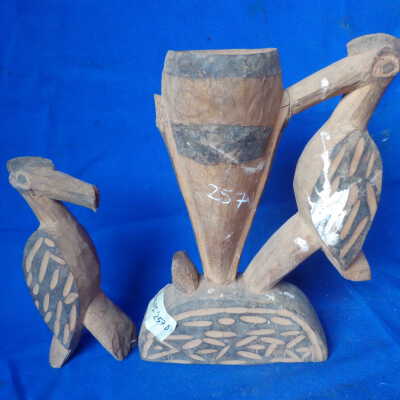
Trophy
Cup set on a base with two birds on either side.
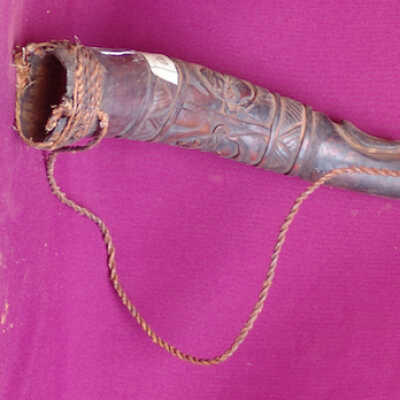
Trumpet
Side-blown trumpet made of a hollowed out cow's horn. Narrow end is carved with a man wearing a traditional cap sitting on a stool. The bell is carved with the heads of three men, some decoration. A braided fiber cord is attached at both ends for carrying it.
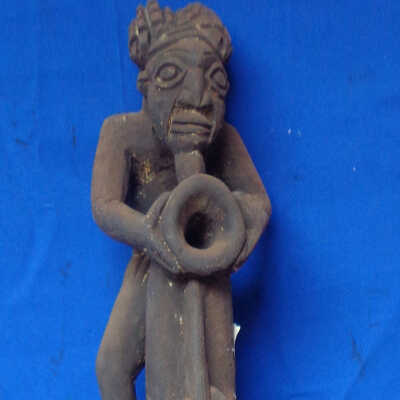
Trumpet
Side-blown trumpet decorated with carvings of lizards facing down its length. A figure of a man wearing a traditional cap and loin cloth forms the top of the instrument. His hands are encircling the mouthpiece and his chin is resting on the tail of one of the lizards. Beneath his feet a ring of lozenge/cowrie shapes are carved around the shaft.
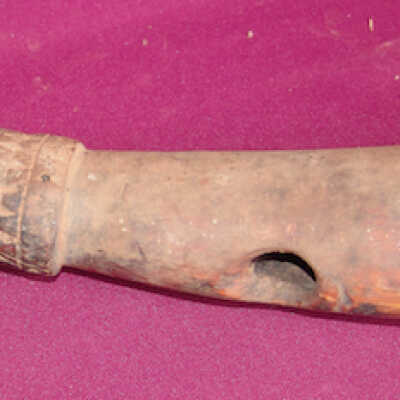
Trumpet
Trumpet carved from an elephant tusk. It is sounded by blowing into a large aperture carved at the narrow end, above which is encircled with a band of geometric carving.
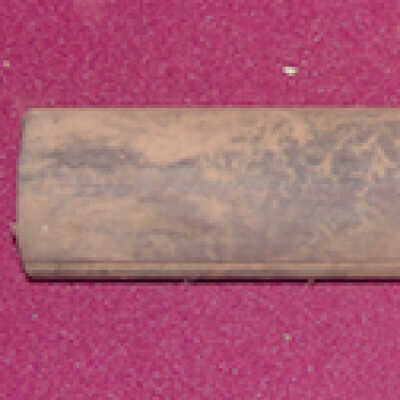
Tube trumpet
Dry bamboo tube that when blown into sounds a pitch
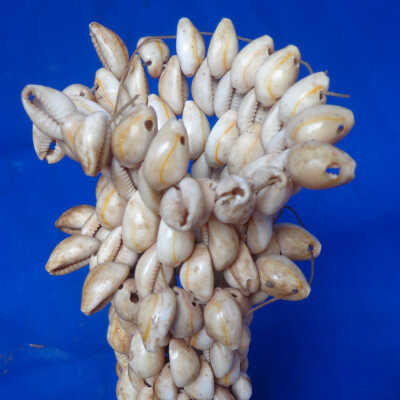
Vase
Vase entirely made of cowries sewn together.
Xylophone
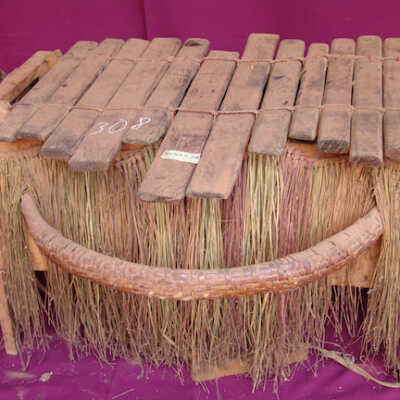
Twelve flat wooden keys held together by cords passing through loops formed by cord passing through two holes on the end of each key, and a second line of cord just held by knots between the keys. Keys are laid on top of a frame containing a line of six resonators made of open calabashes that are hanging from a metal piece that passes through holes near their tops. They sit inside a frame made of wood planks with bent cane handles at each end. The frame is covered by strands of red, green and yellow colored raffia fiber. The keys are held on a removable frame of 2 cm x 1 cm pieces of wood and secured at one end with rubber tire pieces and buffered by pieces of foam.
Xylophone keys
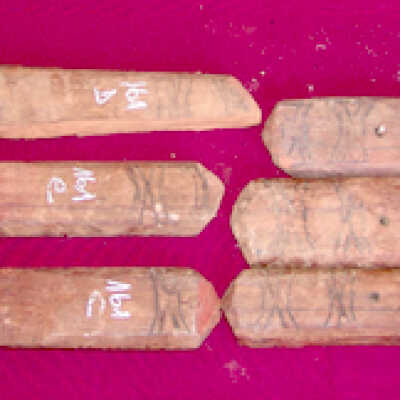
Flat wooden keys of different lengths and widths giving different pitches when struck. Decorated with crude spider shapes, carved into the ends and blackened. Each key has two holes at one end for attaching to completed instrument