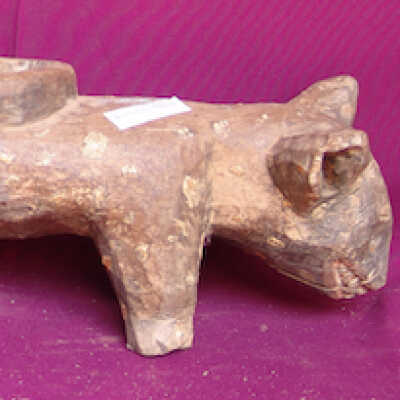
Zoomorphic sculpture of a leopard carrying a round ashtray on its back with carved, white painted spots
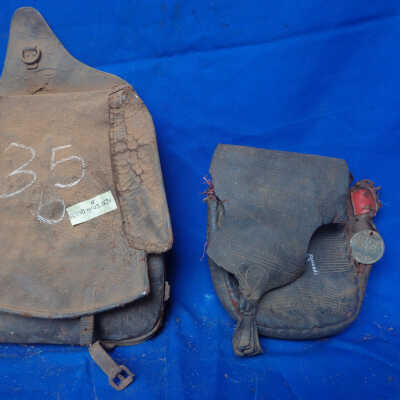
Two old leather bags."A" is curved at the bottom and has a flap that is cut in curved shapes, ending in a leather tassel. The surface of the bag and flap is covered with geometric designs overall. Attached to one side is a coin that reads "Bamenda No. 42021 1938." "B" appears to have been a backpack and has buckled straps and metal loops attached.
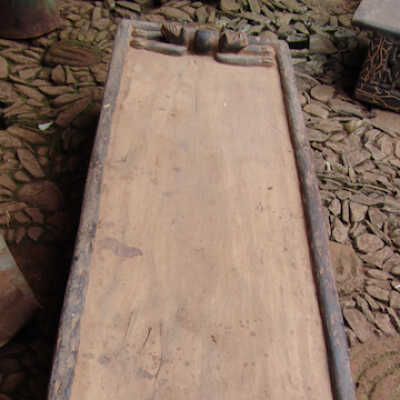
Top is an unfinished undecorated plank save for double leopard pillow. Leopards are just front half, connected in their upper bodies, facing out to either side. One long side is supported by figures of four men holding up the bed with their joined arms, with three dogs heads nose down with ears touching the men. Other sides are plain and open.
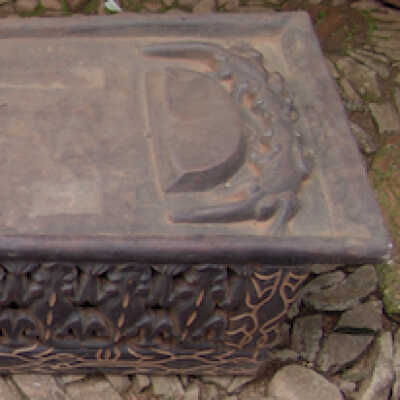
Bed has solid top with a raised rim all around it. Carved pillow with half moon shape, above which are two crocodiles that surround it, nose to nose. Sides are made of twelve reptiles side by side holding up the top with their arms, which are linked to each others, tails curl towards each others and touching. Three carved gashes on their backs. The corner supports and bottom rails of the long sides are also decorated with reptile shapes, head to tail, carved just as lines, more simply than the three dimensional vertical supporting ones. Head and foot are open.
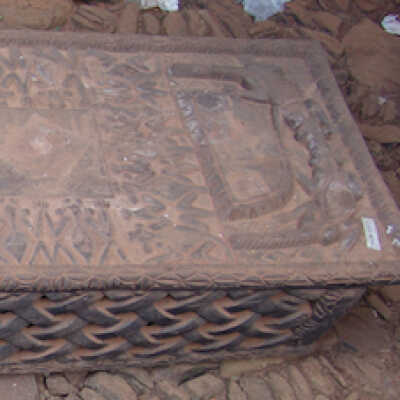
Bed has a highly decorated top. Rounded edges on the long sides are chains of cowries in star pattern. Carved on the short edges are successive double gong shapes in a chain. Pillow is a half moon flat raised area with double gongs carved around its edges. Above the pillow are two crocodiles that are nose to nose and surrounding the pillow with their bodies and tails. Their scales and tails are well carved. The center is a plain rectangle surrounded by 24 crocodiles side by side touching arms and legs to the next one, with noses to the rectangle and bottoms touching the carved edges. Each corner of the supporting sides has a vertical crocodile nose to the top tail down. The sides are carved like weaving, with open space in diagonal/diamond shapes. The bottom rim is also chain of cowries. The head and foot are open, no carving.
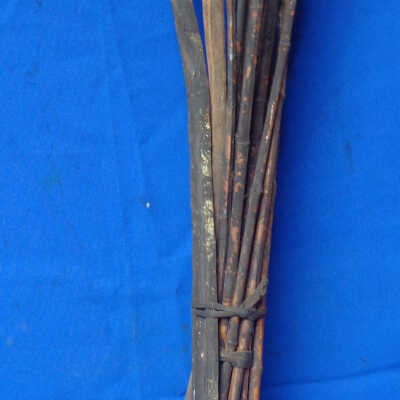
Set of 3 unstrung bows and 15 arrows tied together with fiber. Arrows have jagged metal tips
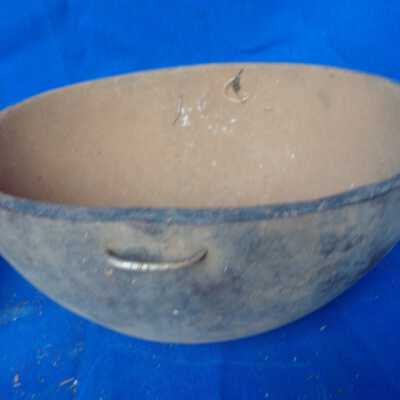
Simple bowl made by halving a calabash. Has a metal wire handle inserted into the side of the bowl
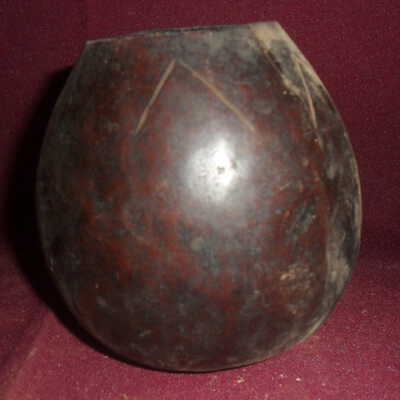
Dark round bowl with "V" shapes carved around the opening.
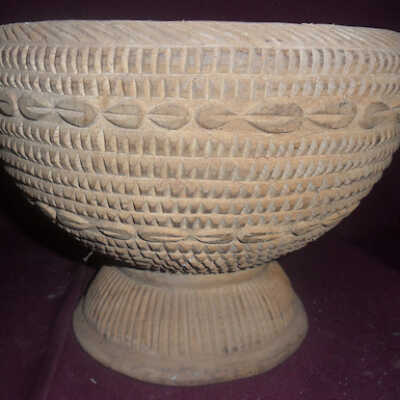
Wide bowl narrowing to a pedestal foot. Surface of the bowl is carved with two rows of cowrie shell shapes in between which are deeply carved textural retangular shapes in an even pattern. The foot is carved with vertical lines, the rim with slanted lines.
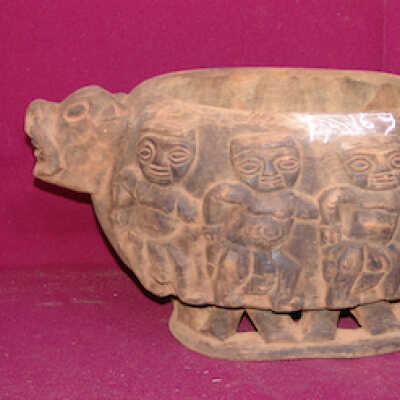
Oval shaped vessel with handles in the form of cow's heads with open mouths showing teeth. Eight men are dancing around the edge of the bowl, linking left arm to right of the one next to him, with left arm down and bent. They are bare chested, wearing loin cloths. The pedestal is carved out in zigzag triangle shapes
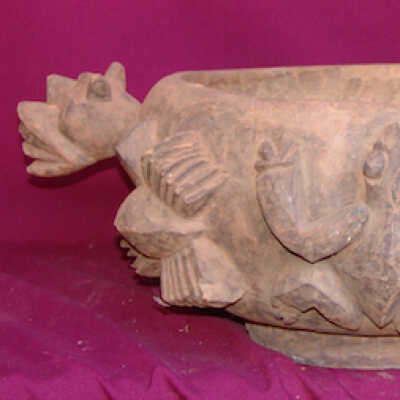
Oval shaped vessel with handles of dog's heads with open mouths showing teeth. Around the sides of the bowl are four spiders interspersed with two frogs facing up towards the rim. The pedestal is low and undecorated.
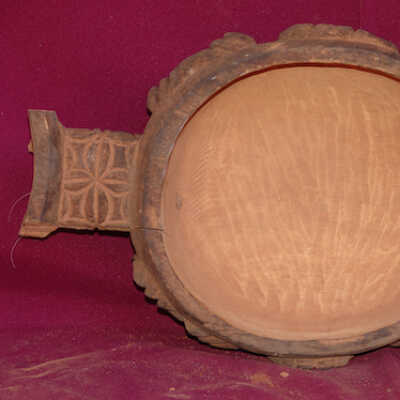
Oval bowl with head at one end and presumably tail at the other. Tail broken well into the rim of the bowl, head is missing. Neck decorated with cowries in star-shaped pattern, four spiders and two double gongs alternate around the sides of the bowl. Plain pedestal
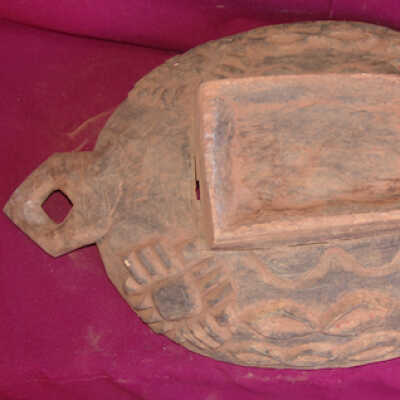
Oval bowl in the shape of a turtle, abstracted head in an open diamond shape at one end forms a handle. Four spiders around the sides, interspersed with five cowrie shapes on each side, totalling ten. Five short gashes under the turtle's head/throat area. Rectangular shaped pedestal. Chisel marks left on the surface
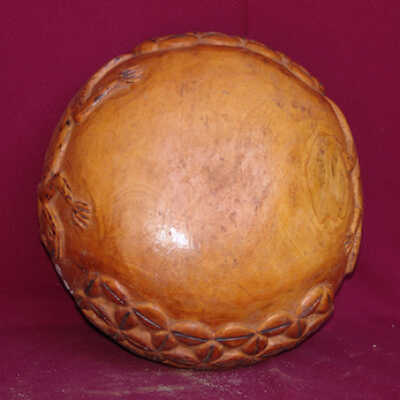
Shallow bowl with a round bottom, sides carved with two spotted lizards and 55 cowrie shapes.
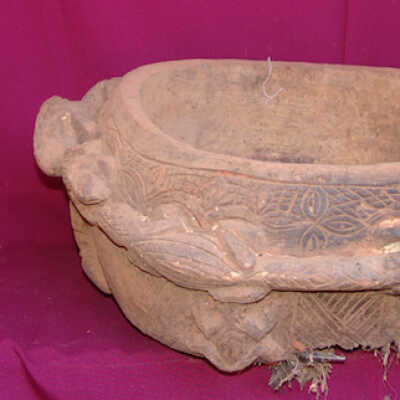
Oval shaped vessel with three figures of frogs forming the handles at both ends. Around the rim of the bowl are four lizards, two on each side facing away from each other with connected tails. Beneath the animals on the rim are two lizards, one underneath each handle and four frogs, two per side, facing up with bottom down to the base. In between the animals are lines, vertical, and slanted. Above the animals at the rim are carved curved lines, rectangular lozenge shapes, and leaf shapes. The pedestal is low and plain, undecorated
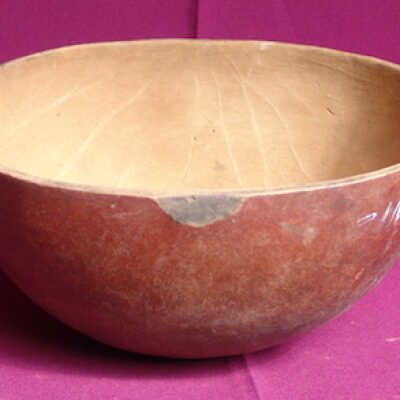
Made from a halved calabash. Has two cracks that have been repaired by stitching with raffia fiber.
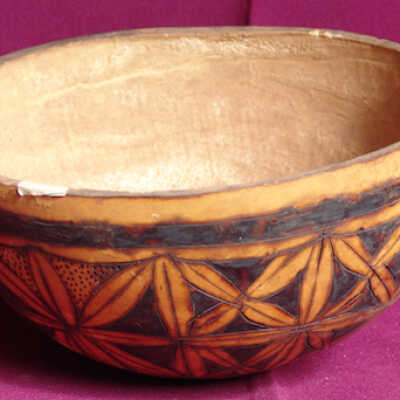
Halved calabash decorated with plant forms by carving and burning.
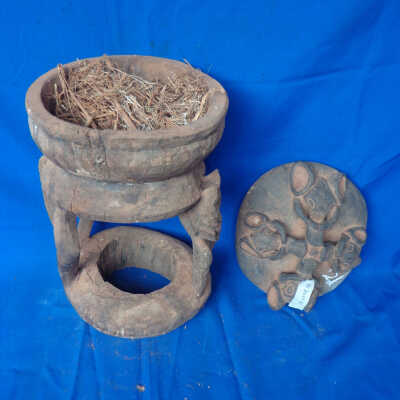
Round lid carved with images of 4 elephant heads with their trunks pointing towards the center on its top. The bowl sits on a pedestal in the form of a leopard that is standing on a circular base. Bowl contains dried grass.
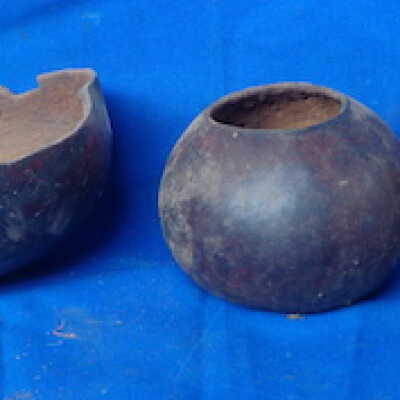
Set of three bowls cut from variety of calabash
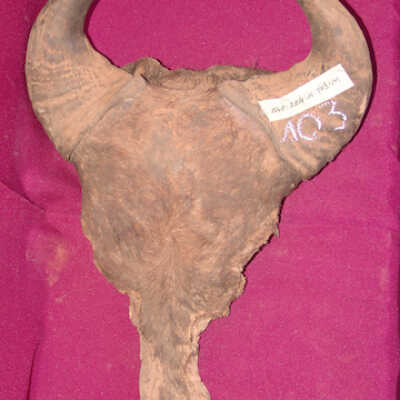
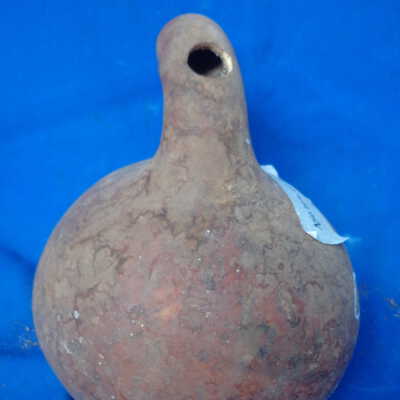
Small calabash that has been hollowed out and a hold made so that it can be used as a drinking vessel
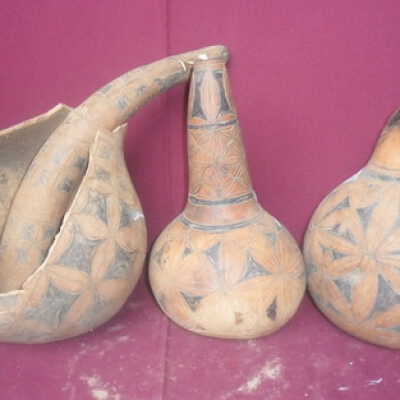
Three calabash wine containers carved with symbols of the Ngiri Society--flower shapes, painted black in between the designs. "A" has a curved neck and "B" has a long straight neck. "C" is broken but interesting in it's design qualities.
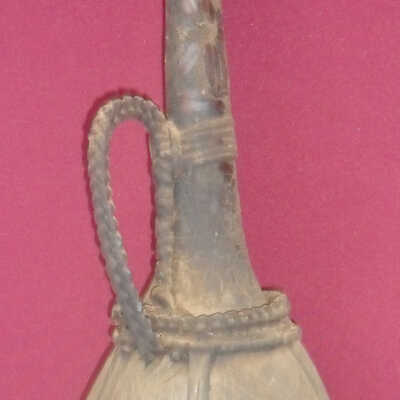
Calabash with a long straight neck set into a carrier made of split bamboo and woven/braided raffia fiber. The vessel is beautifully carved with floral shapes.
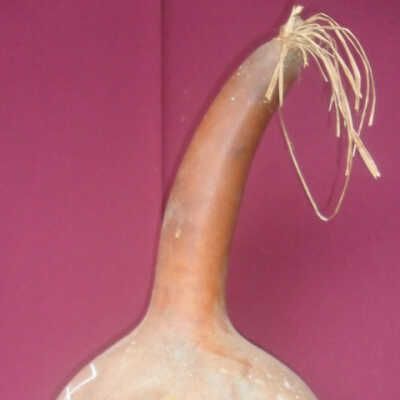
Plain calabash with raffia in the spout
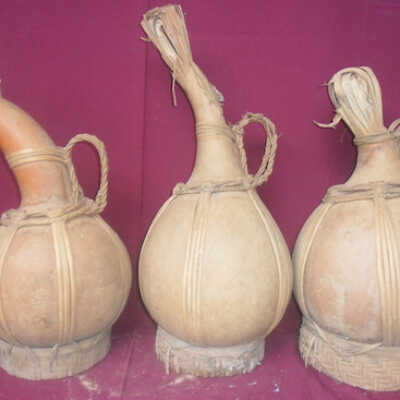
Three undecorated calabash set into woven/braided raffia and bamboo fiber carriers. Mouth of each is filled with raffia.
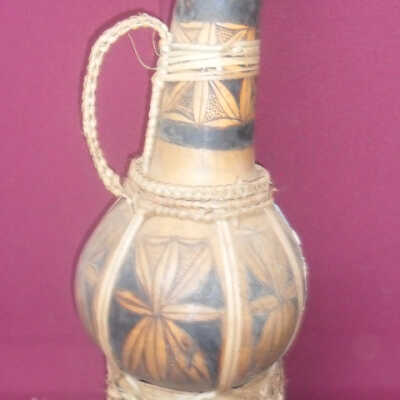
Calabash with a long slightly curved neck engraved by burning with floral designs and bands around the neck. Set into a carrier of woven and braided raffia fiber.
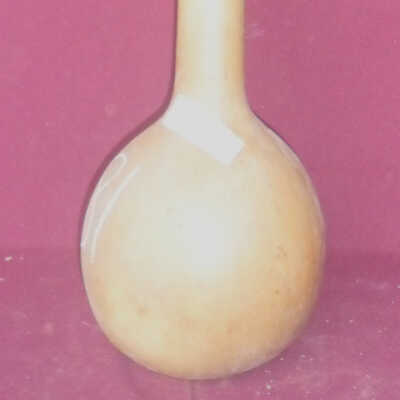
Small calabash with a very long neck carved out to hold liquid.
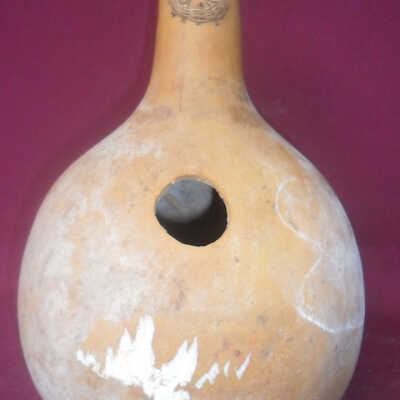
Squat calabash with a large opening on the side and a circular woven decoration on the neck.
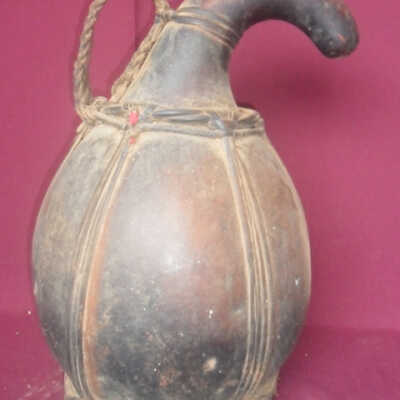
A hollowed out calabash with a carved hole in which to pour palm wine. Wrapped in a carrier made of strips of raffia and woven and braided raffia leaves.
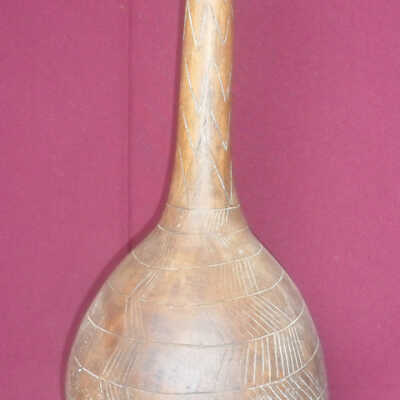
Calabash with a very long straight neck that has been hollowed out to serve as a container. It has been decorated with carved zigzag patterns around the neck and slanted line patterns around the body. A foot has been carved out of the bottom for it to rest on.
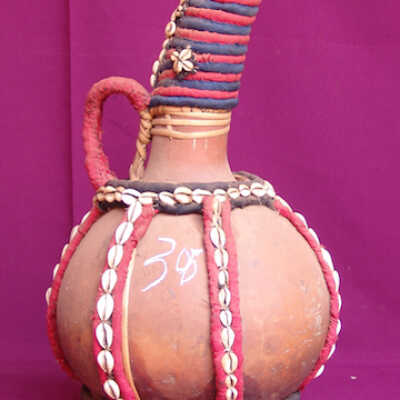
Plain calabash sewn into a stand and cover made with a woven raffia base, held by six red fabric covered strips decorated with chain of cowries sewn end to end that connect to a black horizontal strip around the base of the neck of the calabash also decorated with the cowries. The horizontal piece is connected by a red fabric covered handle to a cover for the narrow end of the calabash. The end cover is raffia wrapped, then covered with strips of red and black thick cording up to the end. The cover is decorated with cowries in groups of four flower shapes, and above the handle with a line of five buttons with two that spread to hold a cowrie flower shape.
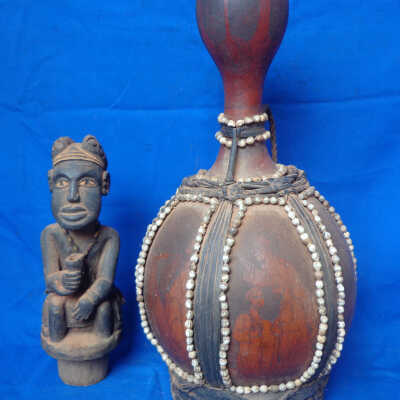
The stopper is the figure of a seated Fon wearing a traditional cap and holding a traditional palm wine cup. The mouth of the vessel is carved with double gongs. It is held in a carrier made of white wooden beads and strips of raffia which create sections around the body of the calabash which are carved with images representing events and language as follows: Pope John II's visit to Cameroon, the Messiah Christ the King, Abraham sighting the Promised Land, He brought forth the stream from the rock, Evildoers: the just ruler cutting of evildoers from the Lord's city.
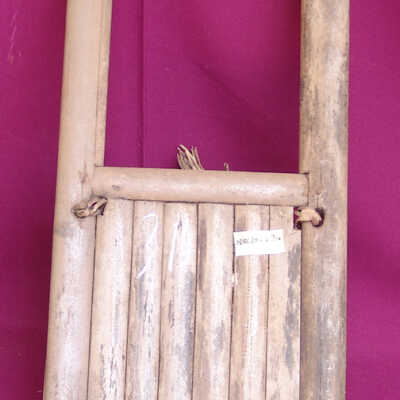
Flat rectangular tray divided in half by slat. One half is open, the other has connected slats on which to rest the calabash. Three-ply raffia cords attach to the frame for holding the calabash in place. Open space is for inserting arm/shoulder.
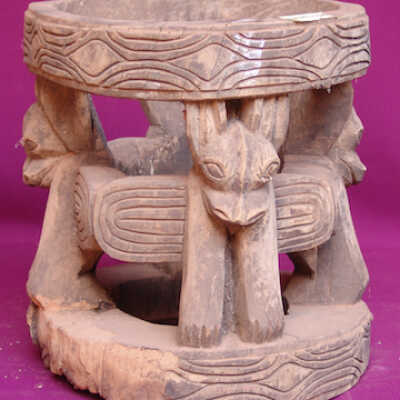
Top of the stand is a circular band decorated with carved curved lines and diamond shapes. Holding up the band are four dog heads with forelegs connecting them to the base, which is like the upper band. Between the dogs are double half oval shapes carved with concentric lines.
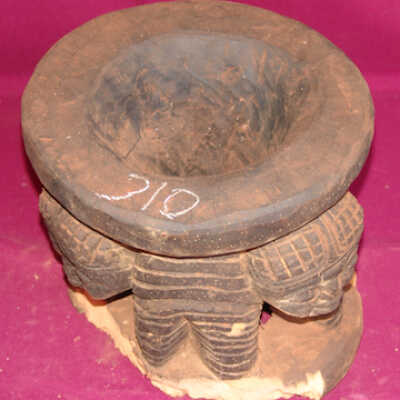
Top of stand is a plain circular band. Held up by four heads at right angles around the rim and round base. In between the heads are pillars that look like waist to knees of a human figure with horizontal curved lines carved into them.
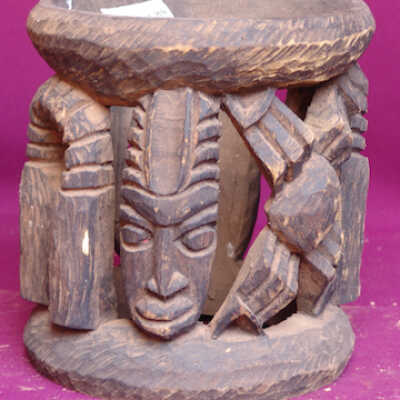
Top of the stand is a plain circular band. Held up by two heads at 180 degrees, two spiders at 180 degrees and two double gongs. Over the spiders' legs are upside down cat ear shapes where their legs attach to the rim. The base is also a rounded band with obvious chisel marks all over.
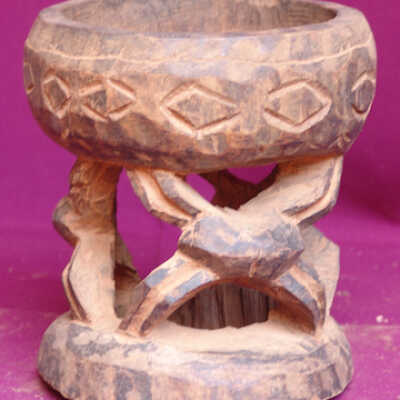
Top of stand is a cylindrical bowl decorated with diamond shapes carved in a ring and horizontal lines above and below. Held up by three spiders connecting to a round base. Crudely carved.
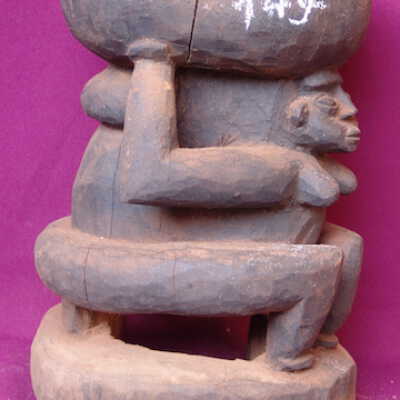
Carving of woman carrying a bowl on her head with arms raised and a child on her back. Her thighs and buttocks form a horizontal circle, as do her upper arms. She is in squatting position, standing with very small feet on an open circular base.
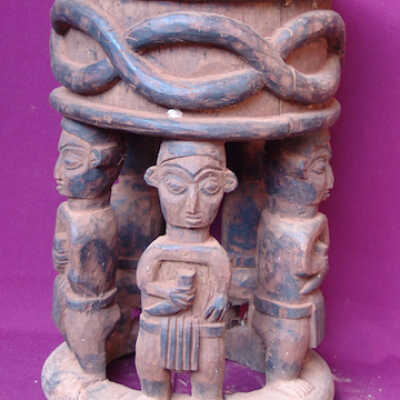
Five male figures wearing loin cloths and traditional caps and holding palm wine cups standing on a circular base. The cylindrical bowl, carved with interlocking waving lines around its sides, sits on their heads.
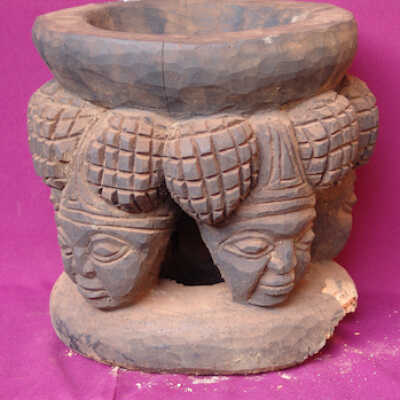
Bowl set into a circular arrangement of six heads wearing carved traditional caps standing on an open circular base.
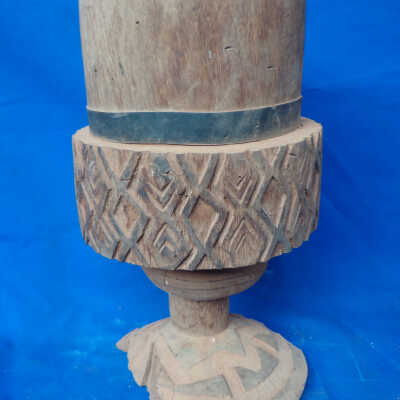
Form has a two-tiered cylindrical top section is smooth, second tier wider and carved over-all with diamond patterns. Set onto a base with a narrow neck that widens out and is carved with complementary geometric patterns. A band of rubber encircles the bottom of the first tier.
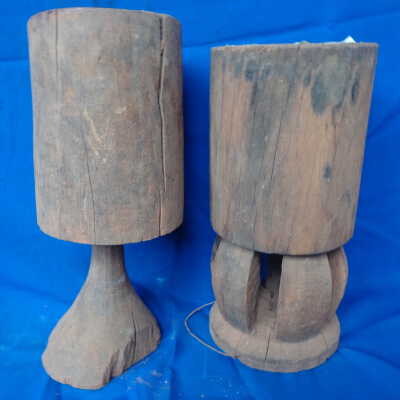
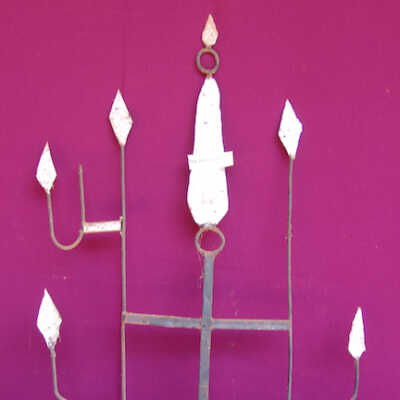
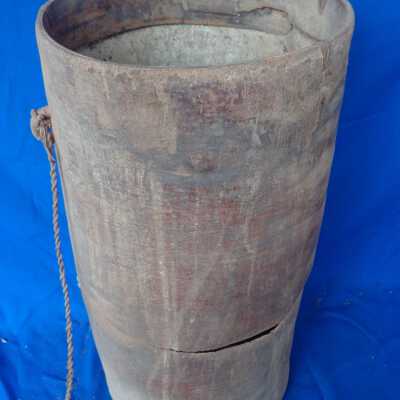
Vessel carved from a tree trunk, tapering towards the base. Fiber covered loop inserted in the side for attaching a fiber carrying cord.
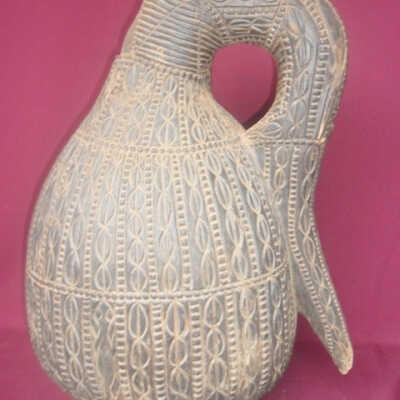
Wooden container carved in the form of a calabash with a long neck that curves over the body of the vessel. The maker inscribed his name along the neck, and dated it on the bottom. The entire object is carved with rows of cowrie shell designs, circle shapes, and two lizards facing nose to nose on the back.
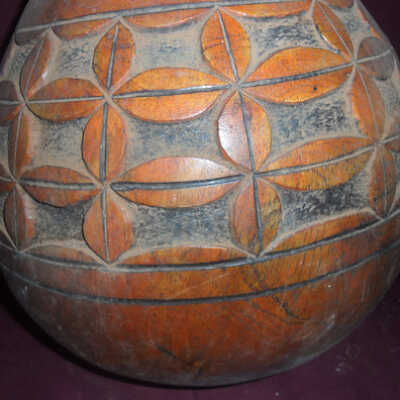
Wooden vessel in the form of a calabash with a long straight neck. Carved and painted with cowie shell shapes arranged in a floral pattern. Capped with a wooden lid decorated with 16 cowrie shells.
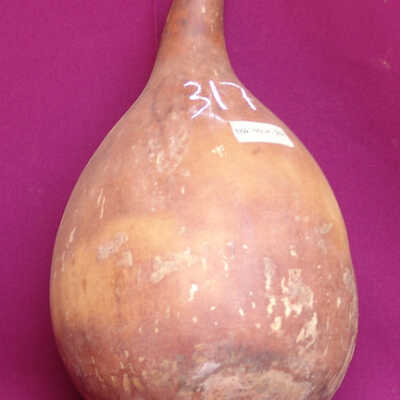
Hollowed out calabash with an enlarged hole in the side for inserting seeds.
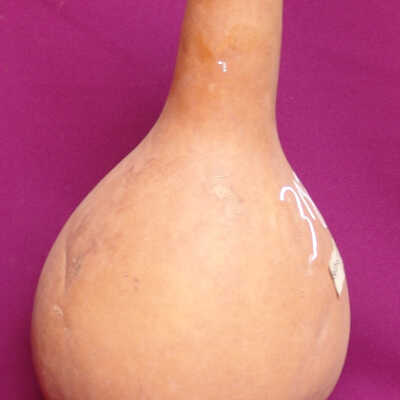
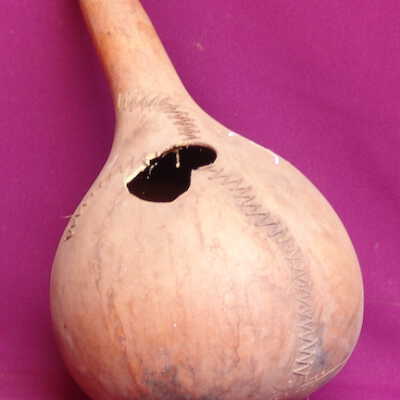
Calabash hollowed out to use for seed storage. Has been broken and repaired with zigzag stitching.
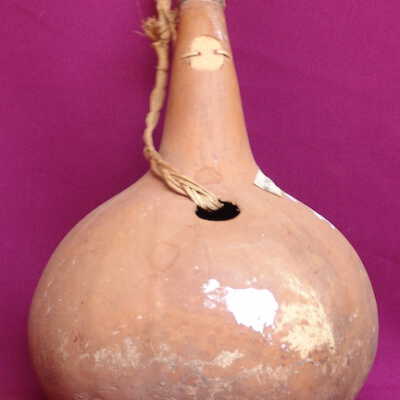
Calabash with three holes, one has been plugged and stitched. Has a braided raffia handle attached at the top and through one of the holes in the side.
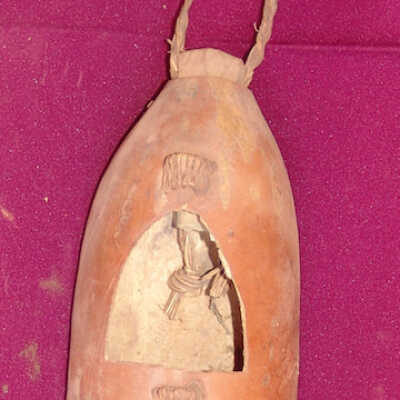
Oblong shaped calabash with a half-moon shaped opening and a handle made of braided raffia.
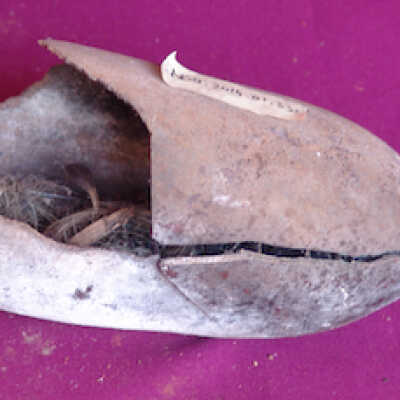
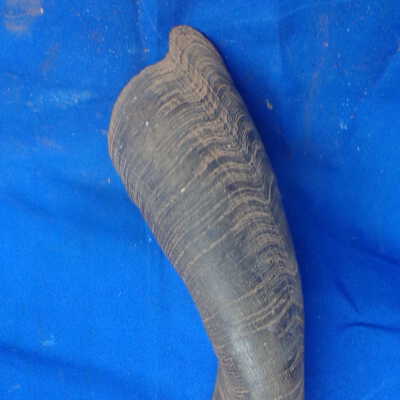
Hollowed out animal horn
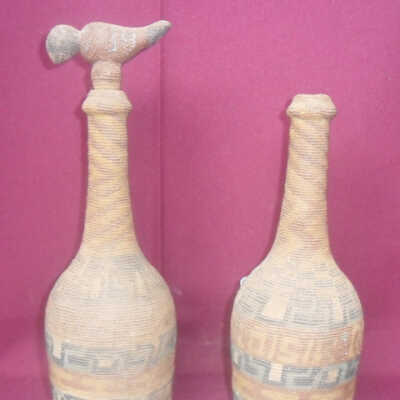
Glass wine bottles decorated with red, black, yellow and white plastic woven in geometric patterns. One of the bottles has a stopper in the form of a bird.
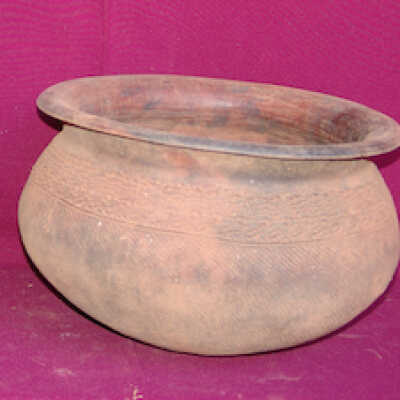
Hand-built terra cotta round bottomed cooking pots decorated with rough texture created by pressing textured cloth onto wet clay, smooth rounded rims.
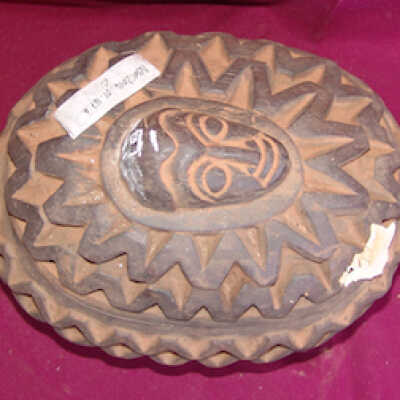
Oval shaped vessel with two handles carved with human head where the handles attach. Sides decorated with two rows of deeply carved zigzag shaped lines. Stands on a pedestal with carved out triangles. Cover fits on top. Handle is a human head like those on the vessel's handles, also decorated with the two tiers of deep zigzag carving.
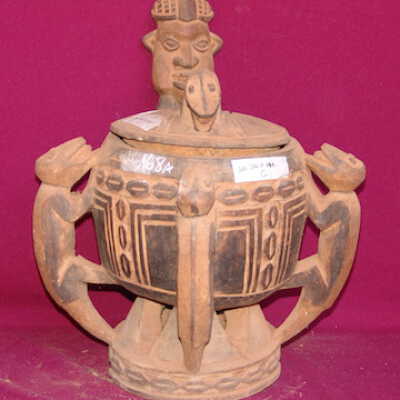
b) Round shaped vessel with one tall handle in the form of a man's bust wearing a traditional cap, extending above the rim. Back of head is not carved with detail. Three chameleon shaped handles evenly spaced around the rest of the vessel, do not extend above the rim. Heads pointing upwards, tails down to the pedestal. Sides in between the handles decorated around the rim horizontally and vertically between by chains of cowrie shapes, and lines. Chain of cowries also around the bottom of the pedestal, which also has carved out triangle shapes above the cowries. Cover fits on top. Handle is a chameleon like the ones on the vessel. Depression carved out in the middle beneath the chameleon. Radial lines extend from the depression out to a circle on the rim.
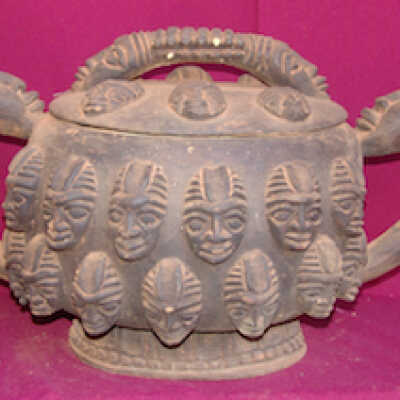
a) Large oval shaped vessel with two handles carved with heads of notables wearing traditional caps. 26 heads carved around the sides of the vessel in two tiers, wearing a simpler cap. Stands on pedestal decorated with vertically carved lines and small rectangular lozenge shapes around the bottom. b) Cover fits on top. Handle spans the top, each end a notable's head with traditional cap that connects the two heads. Six other carved faces decorate around the top of the cover and are like those on the vessel itself.
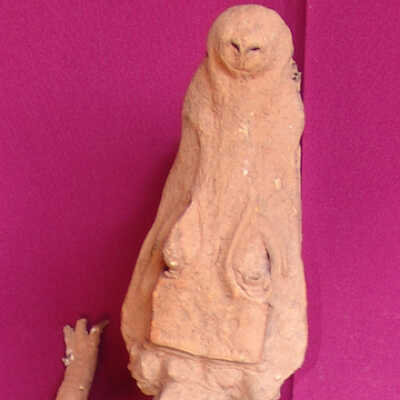
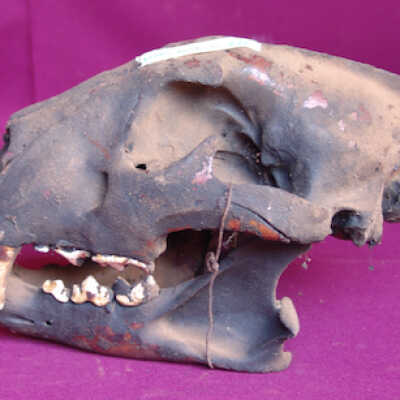
Taxidermy specimen of a small crocodile.
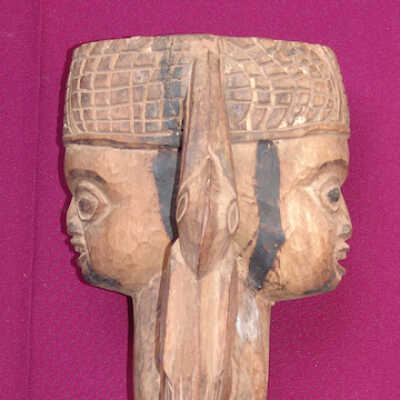
Cup in the form of a Janus face head wearing traditional caps, with carved and black painted features and beards. Handle in the form of a tucan on one side, the other shows evidence of one that is missing. Cup sits on a tall, three tiered round base carved with leaf and rectangle designs.
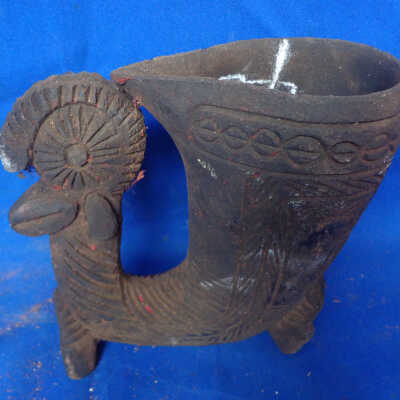
U-shaped cup with a handle in the form of a cock. Edge of the cup is decorated with carved cowrie images. Under the cock's head is carved with double gong image. On the back at the base is the image of a man's face.
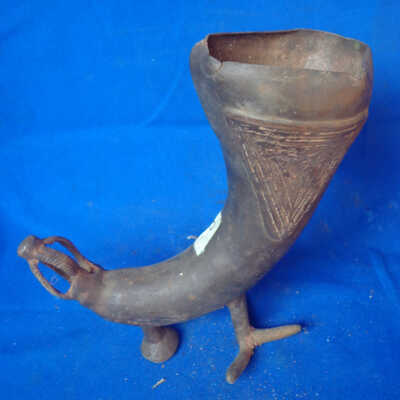
Horn shaped cast iron cup decorated with engraved triangles. Cup sits on two legs.
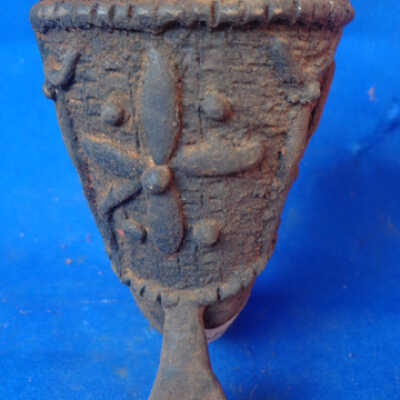
Cast iron horn shaped cup decorated with beaded lines and organic shapes. Cup sits on the point and a triangular shaped foot.
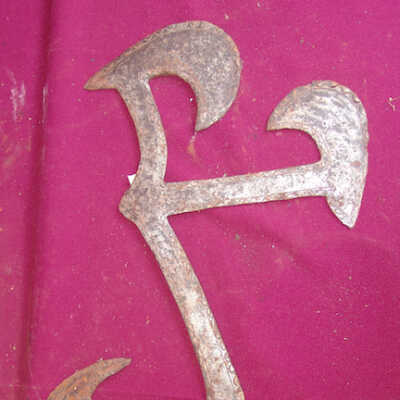
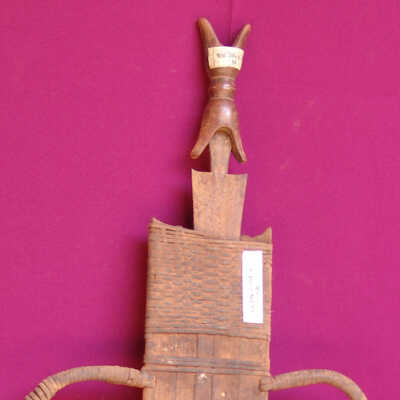
Iron cutlass with a carved wooden handle encased in a flat, woven bamboo scabbard with semi-circular handles on each edge.
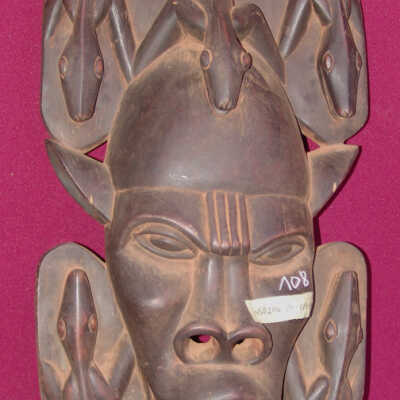
Decorative mask of a gorilla head with an open mouth, large teeth, its tongue protudes a bit. Open nostrils, vertical scarification between the eyes, which are not carved through. Three upside down lizards sit on top of the head and two right side up lizards below the chin forming an oval shape overall for the mask.
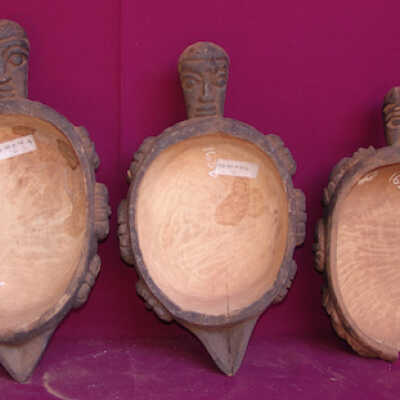
Bowls in the shape of a turtle with a tail at one end and a human head at the other. "A" has six double gongs carved around the sides of the bowl with circle shapes in between. Human head has carved hair. "B" is the same as "A". "C" has alternating double gongs and spiders carved around the sides, four spiders and two gongs. Head shows partially shaved area on top. All bowls sit on short pedestals and are blackened on the exterior, bare wood inside.
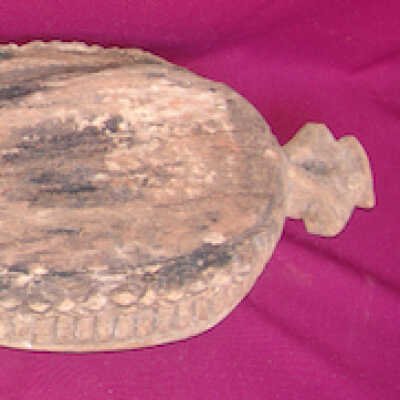
A. Bowl in the shape of a turtle with a tail at one end and what might have been a leopard head at the other. Sides carved with two spiders on each, totaling four, and textured like reptile skin. B. Bowl in shape of turtle with tail missing, what looks like a human head at the other end. Sides carved with four spiders on each side, textured with vertical lines.
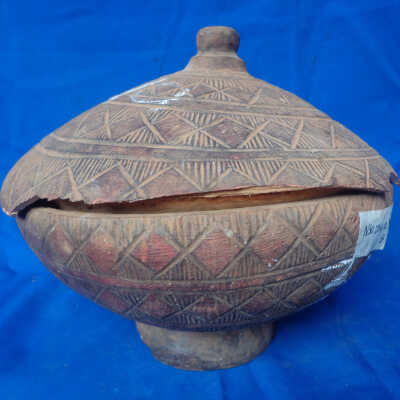
Bowl and cover are carved with diamond and line patterns typical of Fulani designs. Diamond shapes are colored with red pigment. Cover is dome shaped coming to a knob handle at the top. Dish tapers to a round raised foot.
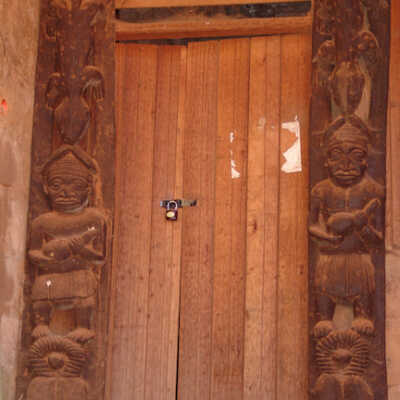
Posts carved with figures of men holding a calabash and wearing traditional caps and loin cloths. They stand on double gongs. Above are chameleons, facing nose down. The lintel is carved with a man's head framed by spiders on either side.
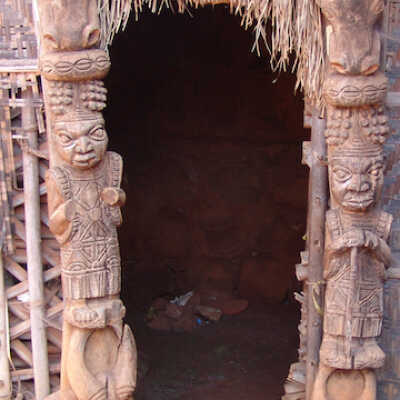
Figure of a title holder (Shuufaay) wearing robes, traditional cap, and holding a staff. He is standing upon and topped by bovine heads and a band of carved cowrie shell shapes between his head and the bovine above.
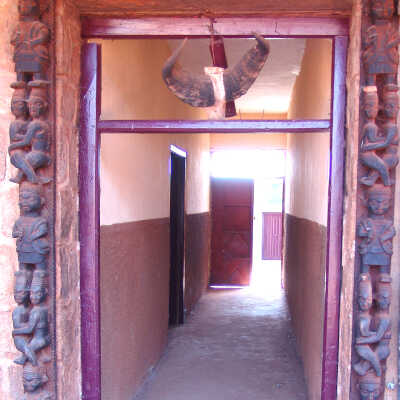
Posts are each carved with three title holders wearing traditional robes, loin cloths and caps. They are holding palm wine cups. In between the single figures are pairs of men wearing onlhy traditional caps. They embracing one another as a symbol of unity and support for the hierarchy. The lintel is carved with three front facing leopards, in between which are two double-headed snakes, the symbol of the Bamoun kingdom, signifying the relationships between the two peoples.
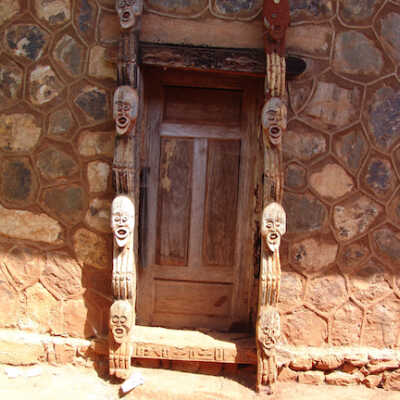
Posts comprised of four heads with open mouths, showing teeth and tongues. Lintel carved with a spider surrounded on both sides by lizards, heads facing the center. Threshold carved with geometric shapes.
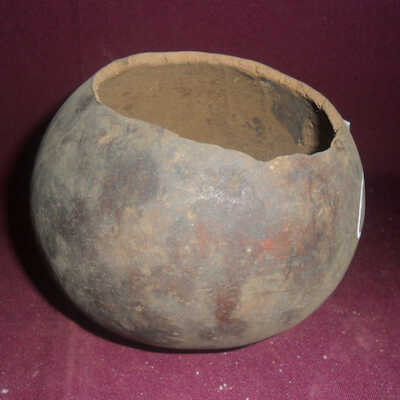
Calabash the has been cut and hollowed out to form a bowl.
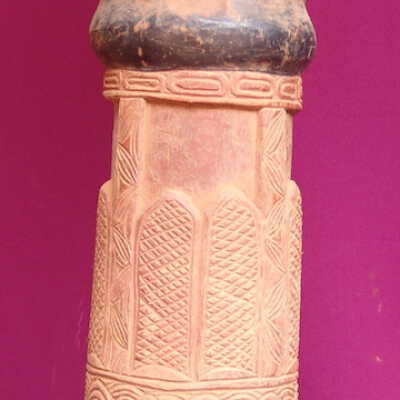
Tall narrow drum carved in four tiers. Upper tier is a parade of 7 overlapping men striding. They wear traditional caps and loin cloths and are carrying walking sticks in their right hands. Some are carrying a log on their left shoulder. Second tier painted black, bordered by a chain of open oval shapes. Third tier is made up of 8 shield shapes in pairs carved in diamond patterns on their surface. In between the double shield shapes are vertical bands carved with wavy lines. Under that tier is a band similarly carved but horizontal. Last tier is carved with four dog heads with forelegs pointing down, in between them are vertical bands carved with wavy lines and leaf shapes.
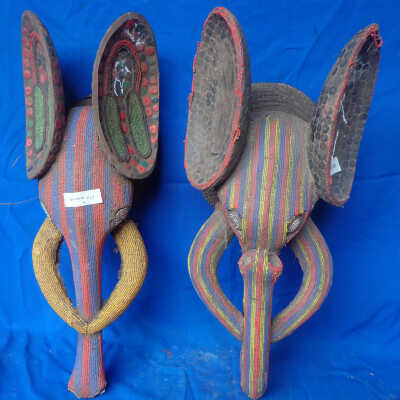
Pair of masks in the form of the head of an elephant. Each entirely covered in multi-colored glass beads. The beads on "A" form narrow red, yellow and blue stripes overall. The ears are covered in black buttons inside and out. The head on "B" is striped red and blue, with yellow tusks. Inside the ears are double gong images in green, black and red beads, surrounded by blue and red buttons. The attached caps that sit on the wearer's head are made of woven raffia.
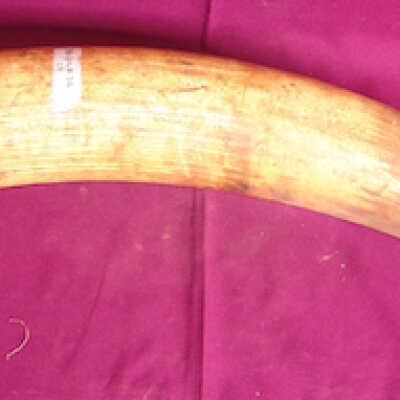
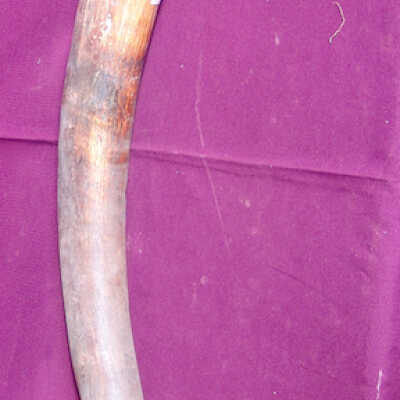
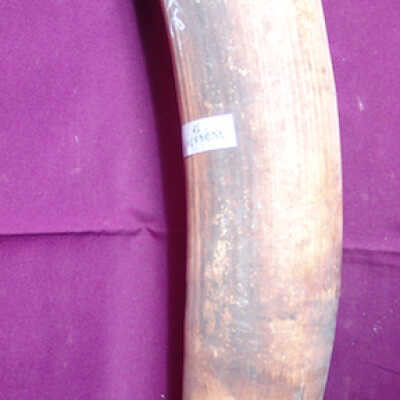
Tusk has been imprinted with numbers, including the dates 1971-72.
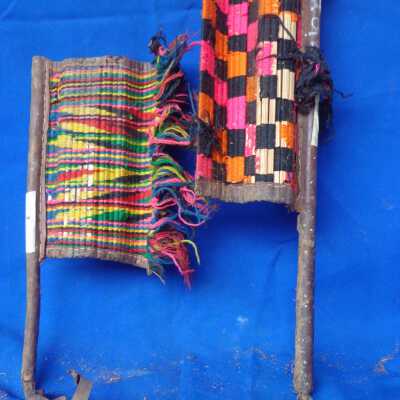
Pair of fans made with woven multi colored wool yarn that is wrapped around strips of split bamboo. Attached to a bamboo handle covered in leather with at leather loop at the end.
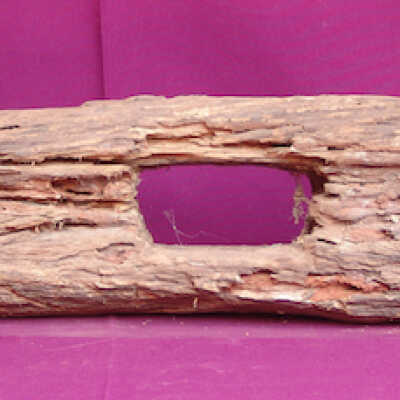
Log that has been carved with a large rectangular hole in the middle, surrounded by smaller perforations
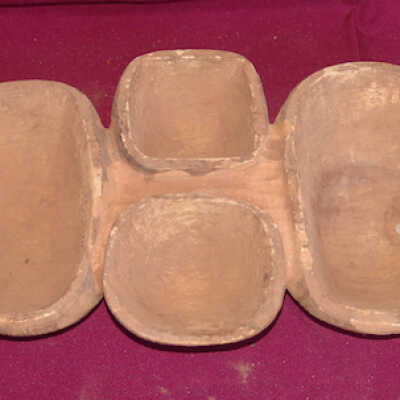
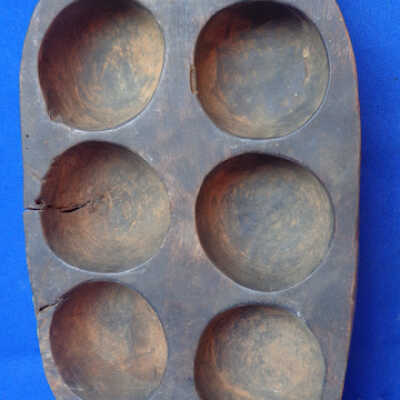
Four bowls carved into one piece of wood, one at each end and two smaller ones together in the middle. Back is finely carved with fine lines in rectangular shapes and grids,and some triangles.
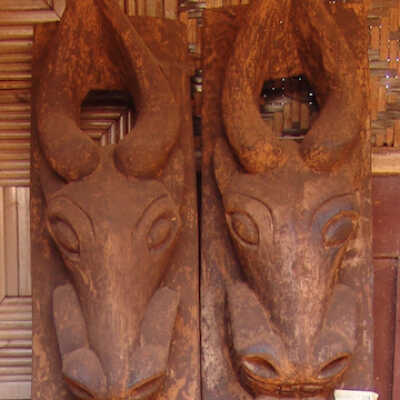
Pair of house posts, each carved with the image of a traditional ruler wearing a cap, loin cloth and carrying a palm wine cup. They are standing on images of a spider, and are topped with images of a bovine head.
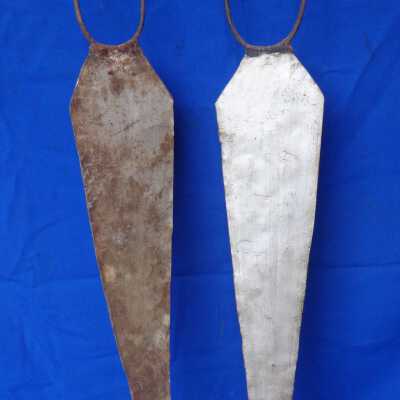
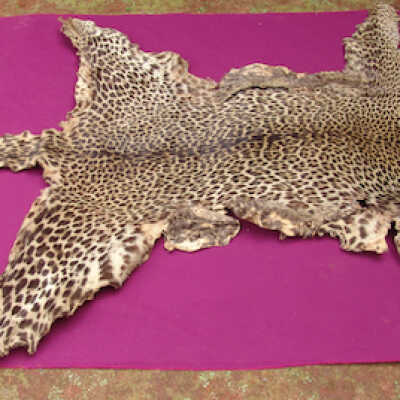
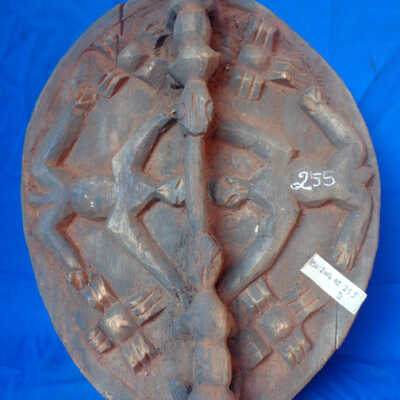
Oval lid carved with two reptiles facing each other that form a handle, and two other reptiles and spiders spiders in relief.
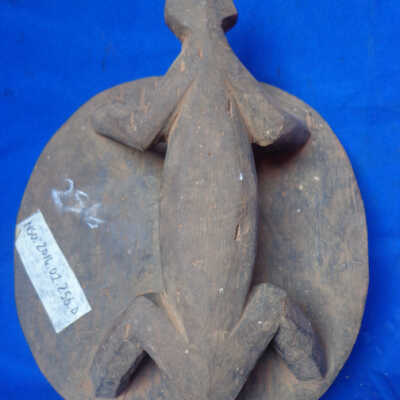
Round lid with large lizard forming a handle. The lizard extends beyond the circumferance of the lid.
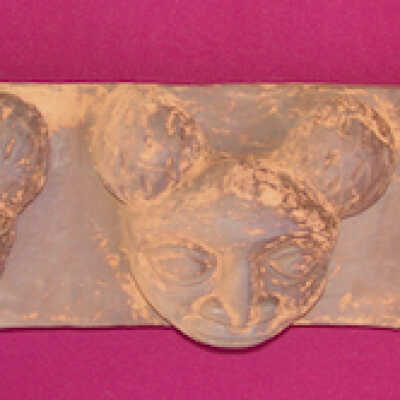
Lintel carved with three men's heads who are wearing traditional caps.
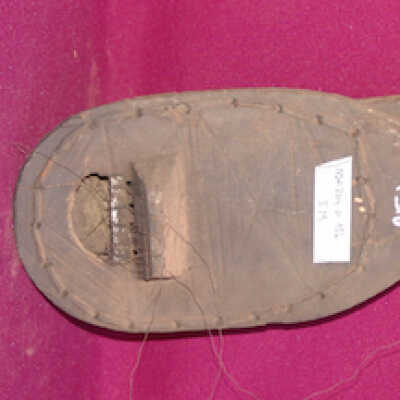
Lute-like instrument with five strings. Raised metal covered bridge, half moon shaped sound hole, oval shaped flat top, curved back. Sides and top decorated with geometric carving. Top attached with fiber stitching. No neck, just five curved sticks, one for each string, extend up above the sound box.
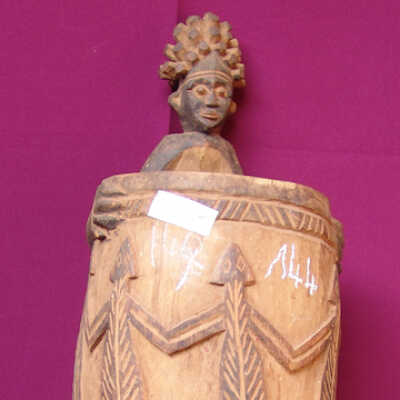
Sculpture of a man being held up by a container that is decorated with five lizards carved and painted black around its surface. He is wearing a traditional cap and has been painted black. The container rests on the front legs of four black lizards standing on a round, hollowed out base.
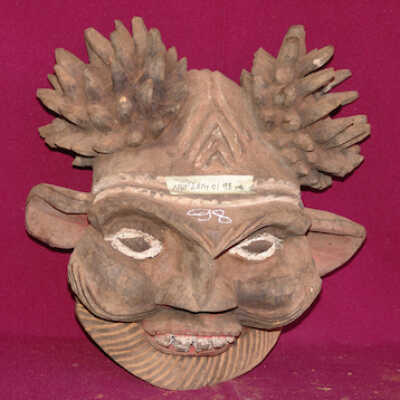
Horizontal anthropomorphic mask representing a Shey (title-holder). He is wearing a traditional divided cap. Has large, open mouth painted red with large white teeth. The eyes are painted white around the edges, as are the forehead lines. He has protruding ears, round cheeks and carved mustache and beard.
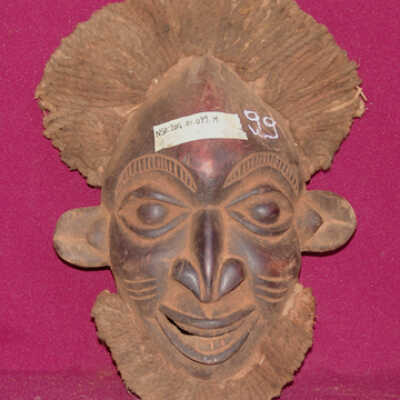
Horizontal anthropomorphic mask with smiling open mouth, teeth, and three horizontal scarification marks on each cheek. Prominent ears and well carved eyebrows. Hair and beard made of plaited fiber. Face has some remnants of red pigment on the forehead and cheeks.
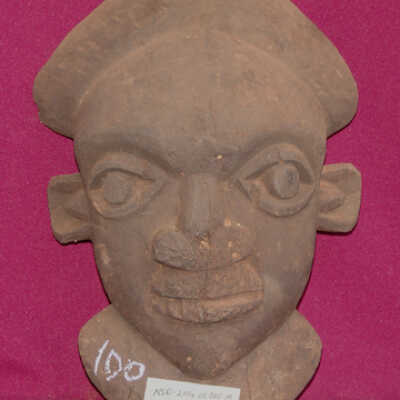
Simply carved orizontal anthropomorphic mask with beard and cap. Traces of black pigment.