Collections

Go back

Architecture

Architectural elements

Door post and lintel

Door post and lintel

Object/Artifact

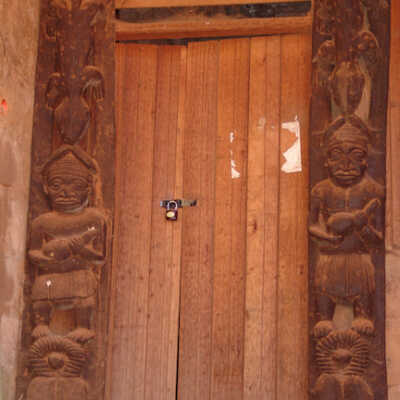
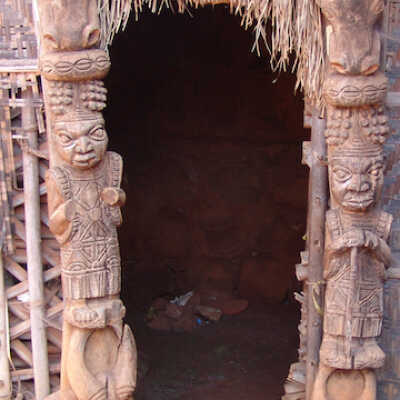
Posts carved with figures of men holding a calabash and wearing traditional caps and loin cloths. They stand on double gongs. Above are chameleons, facing nose down. The lintel is carved with a man's head framed by spiders on either side.
Door posts

Door posts

Object/Artifact

Figure of a title holder (Shuufaay) wearing robes, traditional cap, and holding a staff. He is standing upon and topped by bovine heads and a band of carved cowrie shell shapes between his head and the bovine above.

Door posts and lintel

Door posts and lintel

Basic Entry

Posts are carved with the image of a title holder wearing a traditional cap and loin cloth, carrying a palm wine cup. He is surrounded above and below by double-gongs. The lintel is carved with a spider in the center, framed by elephant tusk trumpets.

Door posts and lintel

Door posts and lintel

Object/Artifact

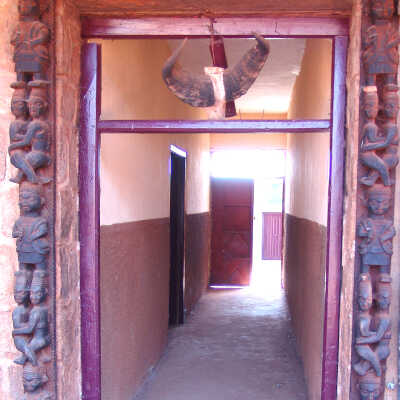
Posts are each carved with three title holders wearing traditional robes, loin cloths and caps. They are holding palm wine cups. In between the single figures are pairs of men wearing onlhy traditional caps. They embracing one another as a symbol of unity and support for the hierarchy. The lintel is carved with three front facing leopards, in between which are two double-headed snakes, the symbol of the Bamoun kingdom, signifying the relationships between the two peoples.

Door way--post, lintel, threshold

Door way--post, lintel, threshold

Object/Artifact

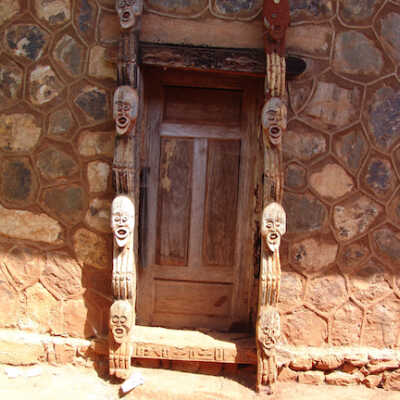
Posts comprised of four heads with open mouths, showing teeth and tongues. Lintel carved with a spider surrounded on both sides by lizards, heads facing the center. Threshold carved with geometric shapes.

Throne room

Throne room

Object/Artifact

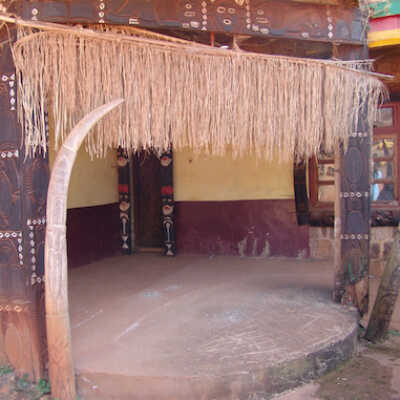
Posts are carved on all four sides with double gongs, combined reptile/spider forms, cowrie shell shapes painted white, and men's faces. Lintel carved with a man's face crowned with cowrie shapes framed by lions in profile on either side, double gongs at the far corners. In front of the posts are large, ornately carved forms of elephant tusks. A branch of raffia palm is placed in front of the lintel to restrict access.